Industrial gear manufacturing involves producing gears designed to transmit power, control motion, and transfer torque in industrial machinery.
Gears are essential components in equipment ranging from conveyor systems and machine tools to turbines, pumps, mining equipment, construction machinery, and industrial gearboxes.
Manufacturing industrial gears requires carefully controlled processes to achieve the required tooth geometry, dimensional accuracy, surface characteristics, strength, and durability. The appropriate production method depends on gear design, material, size, production volume, and performance requirements.
What Is Industrial Gear Manufacturing?
Industrial gear manufacturing is the process of producing gears for mechanical power-transmission systems. The process can include material preparation, machining, heat treatment, finishing, inspection, and final assembly.
Industrial gears can range from relatively small precision components to very large gears used in heavy machinery.
Common Gear Requirements
Industrial gears may need to withstand:
- High torque
- Repeated loading
- Shock loads
- High rotational speeds
- Temperature variations
- Continuous operation
- Vibration
- Abrasive environments
- Heavy mechanical loads
These requirements influence the gear material, tooth profile, manufacturing process, heat treatment, and finishing method.
Types of Industrial Gears
Different gear designs are selected according to the direction of power transmission, operating speed, load, and equipment configuration.
Spur Gears
Spur gears have straight teeth positioned parallel to the gear axis. They are relatively straightforward in design and are commonly used for parallel-shaft power transmission.
Typical applications include machinery drives, conveyors, and industrial mechanisms.
Helical Gears
Helical gears have angled teeth that engage progressively. This design can provide smoother and quieter transmission compared with straight-tooth configurations.
They are frequently used in industrial gearboxes, compressors, conveyors, and other power-transmission equipment.
Bevel Gears
Bevel gears transmit motion between intersecting shafts. Their conical geometry allows changes in the direction of power transmission.
They are used in industrial drives, vehicle systems, machinery, and specialized mechanical equipment.
Worm Gears
Worm gear systems consist of a worm and worm wheel. They are commonly used where a large speed reduction is required within a compact arrangement.
Applications include lifting mechanisms, conveyors, positioning systems, and industrial machinery.
Planetary Gears
Planetary gear systems contain a central sun gear, planet gears, and a ring gear. Their compact structure can provide high torque density and multiple transmission ratios.
They are used in industrial transmissions, robotics, automation systems, and heavy machinery.
Rack and Pinion Systems
A rack and pinion converts rotational movement into linear movement. These systems are used in positioning equipment, automation machinery, steering mechanisms, and industrial motion systems.
Industrial Gear Manufacturing Process
Gear production typically involves several stages.
1. Material Selection
The manufacturing process begins with selecting a suitable material according to the required strength, hardness, wear resistance, and operating environment.
Common materials include:
- Carbon steel
- Alloy steel
- Stainless steel
- Cast iron
- Bronze
- Brass
- Engineering polymers
For demanding applications, alloy steels are frequently considered because of their mechanical properties and suitability for heat treatment.
2. Gear Blank Preparation
The selected material is converted into a gear blank with the required basic dimensions.
Blank preparation may involve:
- Cutting
- Forging
- Casting
- Turning
- Machining
The selected method depends on gear size, material, design, and production requirements.
3. Gear Tooth Machining
Gear teeth are then created using specialized machinery.
Common processes include:
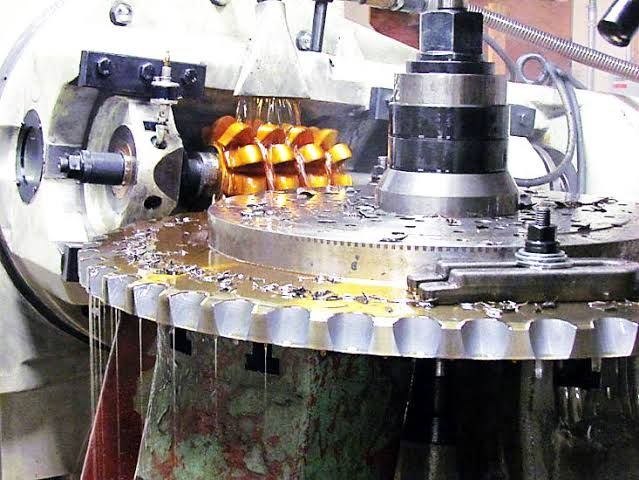
- Gear hobbing
- Gear shaping
- Gear milling
- Gear broaching
- Gear grinding
The choice depends on the gear type, tooth geometry, accuracy requirements, and production volume.
4. Heat Treatment
Heat treatment can modify the mechanical properties of the gear.
Common processes include:
- Carburizing
- Nitriding
- Induction hardening
- Through hardening
- Tempering
The objective is typically to achieve an appropriate combination of surface hardness, wear resistance, toughness, and dimensional stability.
5. Gear Finishing
Finishing processes can improve tooth geometry and surface characteristics.
Common finishing methods include:
- Gear grinding
- Honing
- Lapping
- Shaving
- Superfinishing
High-precision applications may require several finishing operations.
6. Inspection
Finished gears are inspected to verify dimensions, tooth geometry, hardness, surface characteristics, and other requirements.
Gear Manufacturing Machinery
Modern gear production uses specialized equipment throughout the manufacturing process.
CNC Gear Hobbing Machines
Gear hobbing machines use a rotating cutting tool called a hob to generate gear teeth. CNC control allows precise coordination between the cutter and gear blank.
Hobbing is widely used for producing spur and helical gears.
Gear Shaping Machines
Gear shaping uses a reciprocating cutter to generate gear teeth. It can be particularly useful for internal gears and certain external gear configurations.
Gear Grinding Machines
Gear grinding is used for high-precision finishing after heat treatment. It can improve tooth profile, dimensional accuracy, and surface finish.
Gear Broaching Machines
Broaching uses a specialized multi-tooth cutting tool to remove material progressively. It can provide efficient production for suitable internal or external gear profiles.
CNC Turning Centers
Turning machines are often used to prepare gear blanks and machine associated surfaces before tooth generation.
Gear Inspection Equipment
Inspection systems can evaluate:
- Tooth profile
- Lead
- Pitch
- Runout
- Tooth thickness
- Concentricity
- Surface condition
Advanced coordinate and gear-measurement systems can generate detailed dimensional reports.
CNC Technology in Gear Manufacturing
CNC technology has significantly expanded the capabilities of modern gear production.
Computer-controlled machines can coordinate multiple machining axes and maintain programmed cutting conditions.
Advantages of CNC Gear Manufacturing
- Repeatable machining
- Precise positioning
- Automated production cycles
- Complex gear geometry
- Digital program storage
- Reduced setup variation
- Integration with inspection systems
CNC systems can also connect with CAD/CAM workflows, allowing digital gear designs to move into manufacturing processes with greater control.
Gear Materials
Material selection strongly influences gear performance.
| Material | Typical Characteristics | Common Applications |
|---|---|---|
| Carbon steel | Good strength and machinability | General industrial gears |
| Alloy steel | High strength and heat-treatment capability | Heavy-duty transmissions |
| Stainless steel | Corrosion resistance | Specialized equipment |
| Cast iron | Good damping and machinability | Industrial machinery |
| Bronze | Good sliding and wear characteristics | Worm gear systems |
| Brass | Machinability and corrosion resistance | Light-duty applications |
| Engineering polymers | Low weight and reduced noise | Selected machinery |
The actual material grade should be selected according to load, speed, temperature, lubrication, environmental exposure, and applicable engineering requirements.
Heat Treatment in Gear Production
Heat treatment is an important part of industrial gear manufacturing because gears can experience significant contact and bending stresses.
Carburizing
Carburizing introduces carbon into the surface of suitable steel components. After subsequent heat treatment, the gear can have a hard surface with a tougher underlying structure.
Nitriding
Nitriding introduces nitrogen into the surface to improve surface hardness and wear characteristics for suitable materials and applications.
Induction Hardening
Induction heating can selectively harden specific areas of a component. It can be useful when localized surface hardness is required.
Tempering
Tempering is often performed after hardening to adjust hardness and toughness and reduce excessive brittleness.
Gear Quality Control
Quality control is essential because small dimensional deviations can affect gear engagement, noise, vibration, wear, and service life.
Dimensional Inspection
Critical dimensions such as outside diameter, bore diameter, tooth thickness, and face width should be verified.
Tooth Profile Inspection
The tooth profile determines how mating gears engage. Specialized gear-measurement equipment can identify deviations from the specified profile.
Runout Measurement
Runout measurements help determine how accurately the gear rotates relative to its reference axis.
Hardness Testing
Hardness testing verifies that heat treatment has produced the intended material characteristics.
Surface Inspection
Surface inspection can identify grinding marks, cracks, pitting, excessive roughness, or other manufacturing defects.
Applications of Industrial Gears
Industrial gears are used across many sectors.
Manufacturing Machinery
Machine tools, production equipment, conveyors, packaging systems, and automation machinery use gears for controlled power transmission.
Mining Equipment
Mining machinery often requires robust gear systems capable of handling high loads, shock conditions, dust, and continuous operation.
Construction Equipment
Construction machinery uses gears in transmissions, drives, winches, pumps, and other mechanical systems.
Energy Equipment
Industrial gears can be found in turbines, generators, compressors, and power-transmission systems.
Material Handling
Conveyors, elevators, hoists, cranes, and other material-handling systems depend on gear mechanisms for controlled movement.
Robotics and Automation
Precision gears are used in robotic joints, actuators, positioning mechanisms, and automated production equipment.
Factors Affecting Gear Performance
Several factors influence the performance and operating life of industrial gears.
Load
Gear teeth must be designed to withstand expected contact and bending loads.
Speed
High rotational speeds increase the importance of balancing, lubrication, tooth accuracy, and surface finish.
Lubrication
Appropriate lubrication reduces friction, heat generation, and wear between mating gear surfaces.
Alignment
Poor shaft or gear alignment can create uneven tooth loading and accelerate wear.
Temperature
Operating temperature affects lubrication characteristics and material behavior.
Contamination
Dust, metal particles, water, and other contaminants can damage gear surfaces and reduce lubrication effectiveness.
How to Select Industrial Gear Manufacturers
When evaluating industrial gear manufacturers, several technical factors should be considered.
Manufacturing Capabilities
Check whether the manufacturer can produce the required gear type, dimensions, tooth geometry, material, and accuracy class.
Equipment
Review available CNC hobbing, shaping, grinding, heat-treatment, and inspection capabilities.
Material Expertise
The manufacturer should understand material selection and heat-treatment requirements for the intended application.
Quality Systems
Review documented inspection procedures, calibration practices, traceability, and applicable quality certifications.
Custom Manufacturing
For specialized machinery, determine whether the manufacturer can produce gears according to engineering drawings, specifications, or custom designs.
Production Capacity
Production capacity should correspond with the required gear dimensions, quantities, delivery schedule, and manufacturing complexity.
Maintenance of Industrial Gears
Proper maintenance can help reduce premature wear and unexpected equipment interruptions.
Important maintenance practices include:
- Inspecting gear teeth regularly
- Maintaining appropriate lubrication
- Monitoring operating temperature
- Checking vibration
- Inspecting alignment
- Monitoring abnormal noise
- Checking for pitting or scoring
- Replacing contaminated lubricant
- Inspecting seals and housings
Condition-monitoring technologies can also be used to detect changes in vibration, temperature, and other operating parameters.
Frequently Asked Questions
What is industrial gear manufacturing?
Industrial gear manufacturing is the process of producing gears for mechanical power transmission in machinery and industrial equipment. It can include blank preparation, tooth machining, heat treatment, finishing, and inspection.
Which machines are used for gear manufacturing?
Common machines include CNC gear hobbing machines, gear shaping machines, gear grinding machines, broaching machines, CNC turning centers, and specialized inspection equipment.
What materials are used for industrial gears?
Common materials include carbon steel, alloy steel, stainless steel, cast iron, bronze, brass, and engineering polymers. Material selection depends on the operating requirements.
Why is heat treatment important for gears?
Heat treatment can improve surface hardness, wear resistance, strength, and toughness. The appropriate process depends on the material and required performance characteristics.
How do I choose an industrial gear manufacturer?
Consider manufacturing capabilities, machine capacity, material expertise, heat-treatment processes, inspection systems, quality procedures, customization capabilities, and production capacity.
Conclusion
Industrial gear manufacturing combines material selection, precision machining, heat treatment, finishing, and quality inspection to produce reliable power-transmission components. Gear hobbing, shaping, grinding, CNC machining, and specialized inspection technologies allow manufacturers to produce components for a wide range of industrial applications.
The appropriate gear design and manufacturing process depend on load, speed, operating environment, gear geometry, material, accuracy requirements, and production volume. Careful engineering and quality control throughout the manufacturing process are essential for achieving the required performance and reliability.