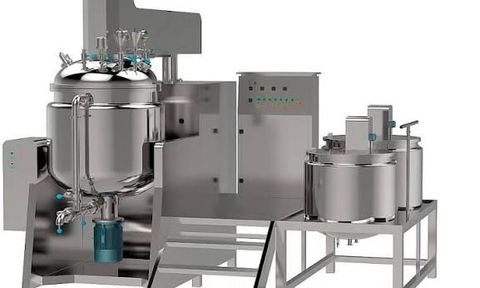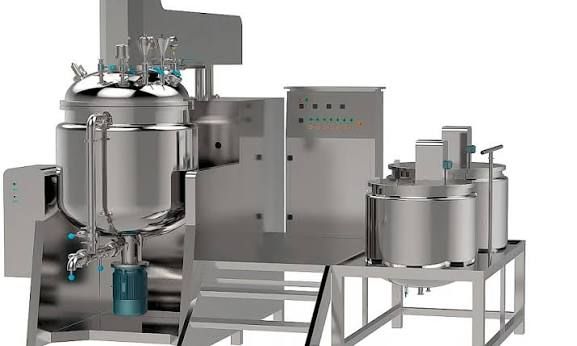
Industrial homogenizers are processing machines designed to reduce particle or droplet size and create a more uniform mixture.
They are widely used in food processing, pharmaceuticals, cosmetics, chemicals, biotechnology, and other industries where consistent product texture, stability, and dispersion are important.
Depending on the design, an industrial homogenizer can use high pressure, high shear, mechanical agitation, ultrasonic energy, or other physical forces. Choosing the appropriate system requires consideration of the material, viscosity, particle size, throughput, pressure, temperature, and required degree of homogenization.
What Are Industrial Homogenizers?
An industrial homogenizer is a mechanical processing system that applies controlled energy to a liquid, suspension, emulsion, or multiphase material to produce a more uniform structure.
The process can help:
- Reduce particle size
- Reduce droplet size
- Improve dispersion
- Stabilize emulsions
- Create consistent textures
- Improve product uniformity
- Distribute ingredients more evenly
- Minimize phase separation
The exact result depends on the formulation and processing conditions.
How Do Industrial Homogenizers Work?
The working principle varies according to the homogenizer design.
1. Product Feeding
The material enters the homogenization system through a feed line, hopper, or pump.
2. Pressure or Shear Generation
The product passes through a specialized processing zone where mechanical energy is applied.
High-pressure systems force the material through a narrow valve or gap. High-shear systems use rapidly rotating elements to generate intense turbulence and shear.
3. Particle or Droplet Size Reduction
The applied forces break larger droplets or agglomerates into smaller structures.
4. Uniform Dispersion
The smaller particles or droplets become more evenly distributed throughout the continuous phase.
5. Product Discharge
The processed material leaves the homogenizer and moves to a storage tank, filling system, heat-treatment stage, or another production process.
Types of Industrial Homogenizers
Different homogenization technologies are suited to different processing requirements.
High-Pressure Homogenizers
High pressure is used to force a product through a specialized homogenizing valve.
The resulting pressure drop and associated physical forces can reduce particle and droplet size.
These machines are widely used for:
- Dairy products
- Beverages
- Pharmaceutical formulations
- Emulsions
- Nutritional products
- Chemical dispersions
High-Shear Homogenizers
High-shear homogenizers use rapidly rotating rotor-stator assemblies.
The material passes through a narrow clearance between the rotor and stator, producing strong shear and turbulence.
They are frequently used for:
- Creams
- Lotions
- Suspensions
- Emulsions
- Slurries
- Liquid-liquid mixtures
Inline Homogenizers
Inline systems are installed directly into a process pipeline.
They allow continuous processing and can be integrated with tanks, pumps, heat exchangers, filling systems, and other production equipment.
Ultrasonic Homogenizers
Ultrasonic systems use high-frequency acoustic energy to generate cavitation within the processing medium.
They can be useful for laboratory, specialty, and selected industrial applications involving emulsification, dispersion, particle-size reduction, and cell disruption.
Rotor-Stator Homogenizers
Rotor-stator systems generate mechanical shear as material passes through the rotor-stator gap.
The gap, rotational speed, flow characteristics, and processing time influence the final result.
Key Components of Industrial Homogenizers
| Component | Main Function |
|---|---|
| Feed Pump | Moves product into the system |
| Homogenizing Valve | Creates high-pressure processing conditions |
| Rotor | Generates mechanical movement |
| Stator | Creates controlled shear zone |
| Motor | Provides mechanical power |
| Pressure Gauge | Monitors operating pressure |
| Product Chamber | Contains processing flow |
| Cooling System | Controls processing temperature |
| Piping | Transfers material |
| Control System | Manages operating parameters |
The exact configuration depends on the homogenizer technology.
Homogenization Methods
Pressure Homogenization
Pressure homogenization forces a product through a restricted passage.
The resulting pressure drop creates intense flow conditions that reduce droplets or particles.
Mechanical Shear
Mechanical homogenizers use rotating components to generate shear forces.
Rotor-stator designs are common where strong mixing and dispersion are required.
Cavitation
Ultrasonic homogenizers create acoustic cavitation. Small bubbles form and collapse rapidly, generating localized forces that can affect particles and droplets.
Turbulence
Rapid fluid movement and turbulence can improve dispersion and contribute to particle or droplet size reduction.
Industrial Homogenizer Applications
Industrial homogenizers are used in several processing sectors.
Food and Beverage Processing
Homogenizers are widely used for products such as:
- Milk
- Cream
- Plant-based beverages
- Sauces
- Dressings
- Mayonnaise
- Nutritional beverages
- Flavor emulsions
In dairy processing, homogenization can help distribute fat globules more uniformly within the liquid.
Pharmaceutical Manufacturing
Homogenization can be used in the processing of suitable:
- Suspensions
- Emulsions
- Creams
- Liquid formulations
- Drug-delivery formulations
Pharmaceutical processing requires carefully controlled parameters and appropriate equipment materials.
Cosmetic Manufacturing
Cosmetic manufacturers use homogenizers for products including:
- Creams
- Lotions
- Gels
- Serums
- Emulsions
- Personal-care formulations
High-shear processing can help produce a smooth and consistent formulation.
Chemical Processing
Industrial homogenizers can process:
- Pigment dispersions
- Coatings
- Adhesives
- Chemical emulsions
- Suspensions
- Specialty formulations
The machine must be compatible with the chemical characteristics of the formulation.
Biotechnology
Selected homogenization systems can be used for cell disruption, biological processing, and other specialized applications.
The technology must be selected according to the sensitivity of the biological material.
Important Industrial Homogenizer Specifications
Several technical parameters affect homogenization performance.
Processing Capacity
Capacity is commonly expressed as:
- Liters per hour
- Liters per minute
- Cubic meters per hour
- Batch volume
The required throughput should match the production process.
Operating Pressure
High-pressure homogenizers are specified according to their maximum and typical operating pressures.
Higher pressure can increase processing intensity, but the appropriate pressure depends on the formulation and desired result.
Motor Power
Motor power determines the mechanical energy available for high-shear and rotor-stator systems.
Viscosity
Product viscosity affects flow behavior, pumping requirements, energy consumption, and homogenization performance.
Particle or Droplet Size
The target particle or droplet size is one of the most important factors in equipment selection.
Temperature
Homogenization can generate heat. Temperature control may therefore be necessary for temperature-sensitive formulations.
Factors Affecting Homogenization Performance
Homogenization results depend on several interacting parameters.
Key factors include:
- Feed composition
- Initial particle size
- Initial droplet size
- Viscosity
- Operating pressure
- Rotor speed
- Processing time
- Number of passes
- Temperature
- Flow rate
- Product concentration
- Equipment geometry
Changing one parameter can influence the effect of the others.
Single-Stage vs Two-Stage Homogenization
High-pressure homogenizers may use either single-stage or two-stage configurations.
| Feature | Single Stage | Two Stage |
|---|---|---|
| Processing Stages | One | Two |
| Pressure Zones | One primary zone | Primary and secondary zones |
| Processing Control | Simpler | More controlled |
| Suitable Applications | Many standard formulations | Selected demanding formulations |
| Equipment Complexity | Lower | Higher |
Two-stage systems can provide additional processing control for certain emulsions and dispersions.
Automation in Industrial Homogenizers
Modern industrial homogenizers can incorporate automated control systems.
Automation may monitor and regulate:
- Pressure
- Temperature
- Flow rate
- Motor speed
- Product level
- Processing time
- Valve position
- Cooling conditions
PLC Control
Programmable logic controllers can coordinate pumps, valves, motors, sensors, and safety systems.
Recipe-Based Processing
Recipe systems can store predefined parameters for different formulations.
This can help maintain consistent processing conditions across production batches.
Data Monitoring
Advanced systems can record operating parameters for process analysis and quality documentation.
Temperature Management
Homogenization can generate heat through pressure changes, turbulence, and mechanical energy.
Temperature management can include:
- Jacketed processing chambers
- Cooling loops
- Heat exchangers
- Temperature sensors
- Automated cooling controls
Temperature limits should be established according to the product formulation and processing requirements.
Cleaning and Hygiene
Hygienic design is especially important for food, pharmaceutical, cosmetic, and biotechnology applications.
Important considerations include:
- Suitable stainless-steel construction
- Smooth product-contact surfaces
- Proper drainage
- Minimal dead zones
- Accessible components
- Appropriate seals
- Clean-in-place compatibility
- Controlled product pathways
Clean-in-place systems can circulate cleaning solutions through suitable equipment without requiring complete disassembly.
Quality Control
Homogenization quality should be evaluated using measurements appropriate to the product.
Particle-Size Analysis
Particle-size measurement can determine whether the homogenization process is achieving the desired reduction.
Droplet-Size Analysis
For emulsions, droplet-size distribution can help assess processing consistency.
Viscosity Testing
Viscosity measurements can identify changes in formulation structure and processing consistency.
Stability Testing
Products can be evaluated for phase separation, sedimentation, creaming, or other stability changes.
Common Industrial Homogenizer Problems
Excessive Temperature Increase
High pressure or intense mechanical processing can raise product temperature.
Potential approaches: optimize pressure, processing passes, cooling capacity, and flow conditions.
Inconsistent Particle Size
Variation may result from unstable pressure, inconsistent feed composition, incorrect rotor speed, or unsuitable processing conditions.
Excessive Foaming
Some formulations can trap air during high-shear processing.
Equipment configuration and operating parameters should be adjusted according to the product characteristics.
Seal or Valve Wear
Continuous operation can gradually wear seals, valves, bearings, and other mechanical components.
Routine inspection helps identify wear before it affects processing performance.
Pressure Fluctuations
Pressure instability can be associated with feed-pump performance, product viscosity, valve condition, or flow restrictions.
Maintenance of Industrial Homogenizers
Regular maintenance is important for reliable operation.
Typical maintenance activities include:
- Inspecting homogenizing valves
- Checking seals and gaskets
- Inspecting bearings
- Monitoring pump performance
- Checking pressure gauges
- Cleaning product pathways
- Inspecting rotor-stator clearances
- Checking motor condition
- Inspecting piping
- Testing safety systems
- Verifying sensors
Maintenance intervals should follow the equipment manufacturer's technical documentation and the operating environment.
How to Select Industrial Homogenizers
Equipment selection should begin with the product and process requirements.
Consider:
- Product type
- Viscosity
- Desired particle size
- Desired droplet size
- Processing capacity
- Operating pressure
- Required shear intensity
- Temperature sensitivity
- Batch or continuous operation
- Cleaning requirements
- Product-contact materials
- Automation requirements
- Available floor space
- Production-line integration
Pilot testing can be useful when the formulation has complex rheological or stability characteristics.
How to Evaluate Industrial Homogenizer Manufacturers
When evaluating industrial homogenizer manufacturers, consider their technical capabilities and equipment configuration.
Important factors include:
- Homogenizer technology
- Pressure range
- Capacity range
- Material compatibility
- Pump design
- Valve configuration
- Rotor-stator design
- Temperature-control systems
- Automation
- Hygienic construction
- Testing capabilities
- Documentation
- Maintenance requirements
A suitable manufacturer should be able to match equipment characteristics with the product formulation and production requirements.
Frequently Asked Questions
What are industrial homogenizers used for?
Industrial homogenizers are used to reduce particle or droplet size and improve the uniformity of liquids, emulsions, suspensions, creams, beverages, and other formulations.
What is the difference between a high-pressure and high-shear homogenizer?
A high-pressure homogenizer forces material through a specialized restriction under elevated pressure, while a high-shear homogenizer uses rapidly rotating mechanical components to generate shear and turbulence.
Which industries use industrial homogenizers?
Food and beverage, pharmaceutical, cosmetic, chemical, biotechnology, and specialty processing industries commonly use industrial homogenization equipment.
Does homogenization increase product temperature?
It can. Pressure drops, turbulence, and mechanical energy can generate heat, so temperature control may be necessary for heat-sensitive products.
How do I select an industrial homogenizer?
Consider the formulation, viscosity, desired particle or droplet size, throughput, pressure or shear requirement, temperature sensitivity, cleaning method, automation level, and production-line configuration.
Conclusion
Industrial homogenizers are important processing systems for creating uniform emulsions, dispersions, suspensions, and other formulated products. High-pressure, high-shear, inline, ultrasonic, and rotor-stator technologies provide different approaches to particle and droplet-size reduction.
Performance depends on formulation characteristics, processing pressure, shear intensity, temperature, flow rate, processing time, and equipment geometry. Proper process control is therefore important for achieving repeatable results.
Modern industrial homogenizers can incorporate PLC controls, sensors, automated pressure regulation, temperature management, recipe systems, and clean-in-place capabilities. Selecting equipment according to the material, required throughput, target particle size, hygiene requirements, and production process can support consistent industrial processing.