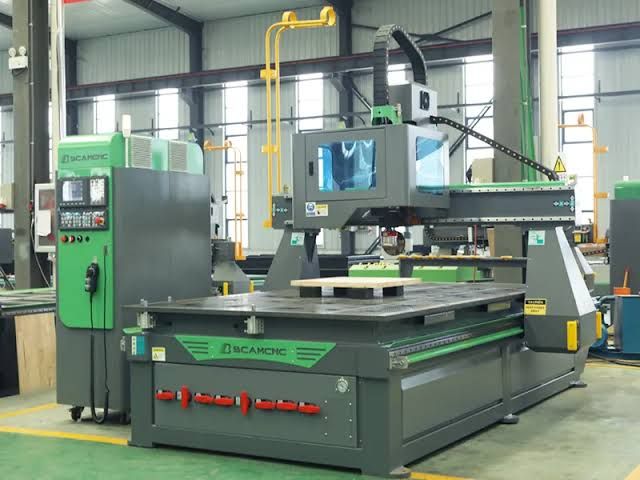
Industrial CNC wood routers are computer-controlled machining systems designed for cutting, carving, drilling, engraving, grooving, and shaping wood-based materials.
They combine CNC programming with high-speed rotary cutting tools to produce accurate and repeatable components for furniture, cabinetry, architectural products, signs, doors, and other woodworking applications.
Modern routers can be configured with automatic tool changers, vacuum tables, multi-axis movement, dust-collection systems, and computerized controls. Machine selection depends on material type, workpiece dimensions, cutting requirements, production volume, spindle performance, precision, automation, and available workspace.
What Are Industrial CNC Wood Routers?
An industrial CNC wood router is a computer numerical control machine that moves a cutting tool along programmed paths.
Unlike manually operated woodworking equipment, CNC routers use digital instructions to coordinate movements along multiple axes.
They can perform operations such as:
- Cutting
- Profiling
- Routing
- Pocketing
- Drilling
- Engraving
- Carving
- Grooving
- Edge shaping
- Three-dimensional machining
Common materials processed by CNC wood routers include solid wood, plywood, MDF, particleboard, laminates, and selected composite boards.
How Do Industrial CNC Wood Routers Work?
The CNC routing process generally involves several stages.
1. CAD Design
A component or product is designed using computer-aided design software.
The digital drawing defines dimensions, contours, holes, pockets, and other machining features.
2. CAM Programming
CAM software converts the design into machine toolpaths.
The program determines:
- Cutting paths
- Tool selection
- Cutting depth
- Feed rate
- Spindle speed
- Tool changes
3. Material Positioning
The wood panel or workpiece is positioned on the machine table.
Vacuum systems, clamps, or other workholding methods secure the material.
4. Tool Movement
The CNC controller directs the machine's axes according to the programmed toolpath.
5. Cutting and Machining
The spindle rotates the cutting tool at high speed while the machine moves the tool through the material.
6. Part Removal
After machining is complete, the finished component is removed and inspected.
Types of Industrial CNC Wood Routers
Different machine configurations are designed for different woodworking requirements.
3-Axis CNC Wood Routers
Three-axis routers typically move the cutting tool along the X, Y, and Z axes.
They are widely used for:
- Panel cutting
- Cabinet components
- Furniture parts
- Sign making
- Engraving
- 2D and basic 3D machining
4-Axis CNC Wood Routers
Four-axis systems add a rotary axis to the conventional three-axis configuration.
They can support more complex machining of suitable workpieces.
5-Axis CNC Wood Routers
Five-axis routers provide additional tool-orientation capabilities.
They can machine complex three-dimensional components and angled surfaces.
Applications include:
- Advanced furniture components
- Sculpted wood parts
- Complex architectural elements
- Specialty woodworking
- Detailed 3D components
CNC Nesting Routers
Nesting machines arrange multiple components on a large sheet to improve material utilization.
They are widely used for:
- Cabinet manufacturing
- Furniture production
- Panel processing
- Interior components
Automatic Tool Change CNC Routers
ATC routers use an automatic tool-changing system.
This allows a programmed machining sequence to switch between tools without requiring manual tool replacement.
CNC Wood Carving Machines
CNC carving systems are designed for decorative and detailed machining.
They can produce:
- Relief patterns
- Decorative panels
- Architectural carvings
- Signs
- Artistic components
Major Components of Industrial CNC Wood Routers
| Component | Primary Function |
|---|---|
| Machine Frame | Provides structural support |
| Spindle | Rotates the cutting tool |
| CNC Controller | Executes programmed movements |
| X-Axis System | Controls horizontal movement |
| Y-Axis System | Controls longitudinal movement |
| Z-Axis System | Controls vertical movement |
| Linear Guides | Guide machine-axis movement |
| Drive Motors | Move the machine axes |
| Worktable | Supports the workpiece |
| Vacuum System | Holds suitable sheet materials |
| Tool Changer | Automatically changes tools |
| Dust Collection | Removes chips and dust |
| Control Interface | Allows operator interaction |
Component specifications vary according to machine configuration and application.
CNC Wood Router Tooling
Cutting tools have a direct influence on machining quality.
Common router-tool types include:
- Straight bits
- Compression bits
- Upcut bits
- Downcut bits
- V-groove cutters
- Ball-nose cutters
- Surfacing cutters
- Spiral bits
Compression Bits
Compression tools can be useful for cutting laminated or layered sheet materials where a cleaner upper and lower surface is required.
V-Groove Cutters
V-groove tools are commonly used for lettering, engraving, decorative lines, and sign work.
Ball-Nose Cutters
Ball-nose tools are suitable for selected three-dimensional carving and curved-surface machining.
Tool selection should consider material, cutting depth, desired finish, spindle speed, and feed rate.
Materials Processed by CNC Wood Routers
Industrial CNC routers can process many wood-based materials.
Solid Wood
Different hardwood and softwood species can require different tooling and machining parameters.
Plywood
CNC routers can cut and profile plywood for furniture, cabinets, structural components, and interior applications.
MDF
MDF is commonly routed for cabinetry, furniture components, signs, and decorative panels.
Particleboard
Particleboard can be machined using appropriate cutting tools and dust-management practices.
Laminated Boards
Laminated panels require suitable tooling and cutting parameters to reduce chipping and surface damage.
Applications of Industrial CNC Wood Routers
Furniture Manufacturing
CNC routers can produce:
- Cabinet components
- Table parts
- Chair components
- Shelving
- Decorative panels
- Furniture joints
Digital machining allows repeated components to follow consistent dimensions.
Cabinet Manufacturing
CNC nesting routers can cut complete panel layouts for cabinet components.
Operations can include:
- Panel cutting
- Drilling
- Grooving
- Pocketing
- Edge-related machining
Door Manufacturing
Routers can produce door panels, decorative profiles, cutouts, and selected architectural details.
Sign Manufacturing
CNC wood routers are used to create letters, logos, relief patterns, and decorative signs.
Architectural Woodworking
Applications include:
- Wall panels
- Decorative screens
- Moldings
- Custom architectural elements
- Carved panels
Musical Instrument Components
Selected CNC routers can machine suitable wood components for musical instruments where precision and repeatability are important.
CNC Router Accuracy and Performance
Several factors influence machining accuracy.
Machine Rigidity
A rigid frame can help minimize unwanted movement during cutting.
Spindle Performance
Spindle power and speed should match the material and cutting requirements.
Linear Motion System
Accurate guides and drive mechanisms contribute to repeatable tool positioning.
Workholding
Secure workholding helps prevent material movement during machining.
Tool Condition
Worn or damaged tools can affect dimensions, surface quality, and cutting behavior.
Automation in Industrial CNC Wood Routers
Modern CNC routers can incorporate automated systems to reduce manual intervention.
Automation may include:
- Automatic tool changing
- Automatic material positioning
- Vacuum workholding
- Automatic drilling
- Tool-length measurement
- Program loading
- Dust extraction
- Production monitoring
CNC Controller
The controller interprets machine-code instructions and coordinates the movement of machine axes.
Automatic Tool Changer
ATC systems allow multiple tools to be used within one machining program.
Vacuum Workholding
Vacuum tables can secure suitable sheet materials over large surface areas.
Dust Collection and Workplace Management
Wood routing produces chips and fine dust.
A suitable dust-collection system can capture airborne particles and machining debris at the source.
Important considerations include:
- Extraction airflow
- Duct configuration
- Filter capacity
- Dust-bin capacity
- Collection-point design
- Filter maintenance
Wood dust can present workplace and fire-related hazards, so dust-control measures should be designed according to applicable safety requirements.
Common Industrial CNC Wood Router Problems
Poor Cutting Quality
Poor surface finish can result from incorrect feed rates, unsuitable tools, worn cutters, excessive vibration, or incorrect spindle settings.
Tool Breakage
Tool failure can occur because of excessive cutting depth, inappropriate feed rates, damaged tooling, or unsuitable tool selection.
Dimensional Errors
Dimensional inaccuracies may result from machine calibration problems, workpiece movement, backlash, tool wear, or incorrect programming.
Material Chipping
Chipping can occur when tooling, cutting direction, spindle speed, or feed rate is not appropriately matched to the material.
Excessive Dust
Poor extraction design, blocked filters, leaks, or insufficient airflow can reduce dust-collection effectiveness.
Maintenance of Industrial CNC Wood Routers
Routine maintenance helps preserve machining accuracy and equipment reliability.
Typical activities include:
- Cleaning the machine table
- Inspecting linear guides
- Checking drive components
- Inspecting spindle condition
- Checking tool holders
- Cleaning dust-collection components
- Inspecting vacuum systems
- Lubricating specified components
- Checking electrical connections
- Verifying axis calibration
- Inspecting safety devices
Maintenance schedules should follow the machine manufacturer's documentation and operating conditions.
How to Select Industrial CNC Wood Routers
Machine selection should begin with the materials and components to be manufactured.
Consider:
- Worktable dimensions
- Material thickness
- Spindle power
- Spindle speed
- Number of axes
- Tool-changing requirements
- Cutting accuracy
- Feed rate
- Vacuum workholding
- Dust collection
- CNC controller
- Software compatibility
- Production volume
- Machine footprint
- Maintenance requirements
For complex applications, machining representative materials and designs can help confirm the appropriate configuration.
3-Axis vs 5-Axis CNC Wood Routers
| Factor | 3-Axis Router | 5-Axis Router |
|---|---|---|
| Axis Movement | X, Y, Z | Five coordinated axes |
| Typical Work | 2D and basic 3D | Complex 3D machining |
| Programming | Generally simpler | More advanced |
| Tool Orientation | Limited | Multi-angle |
| Application | Furniture, cabinets, panels | Complex components and specialty work |
| Equipment Complexity | Generally lower | Generally higher |
The appropriate configuration depends on part geometry, machining requirements, and production objectives.
How to Evaluate CNC Wood Router Manufacturers
When evaluating industrial CNC wood router manufacturers, consider their machine engineering and technical capabilities.
Important factors include:
- Machine frame construction
- Spindle specifications
- Axis-drive technology
- Working dimensions
- CNC controller
- Tool-changing system
- Vacuum-table configuration
- Dust-collection integration
- Software compatibility
- Machine accuracy
- Safety systems
- Testing procedures
- Technical documentation
- Maintenance requirements
The manufacturer should be able to match the router configuration with the materials, component dimensions, machining operations, production volume, and required precision.
Frequently Asked Questions
What are industrial CNC wood routers used for?
Industrial CNC wood routers are used for cutting, carving, drilling, engraving, profiling, grooving, and shaping wood and wood-based materials. They are widely used in furniture, cabinetry, architectural woodworking, signage, and technical applications.
What materials can CNC wood routers process?
Depending on machine configuration and tooling, CNC routers can process solid wood, plywood, MDF, particleboard, laminated boards, and selected composite materials.
What is the difference between a 3-axis and 5-axis CNC wood router?
A 3-axis machine typically moves along X, Y, and Z axes, while a 5-axis machine provides additional rotational or angular tool movement. Five-axis systems are suited to more complex three-dimensional machining.
Why is spindle selection important?
The spindle determines available rotational speed and power for machining. Its specifications should match the material, tool diameter, cutting depth, feed rate, and required surface finish.
How do I select an industrial CNC wood router?
Evaluate worktable dimensions, material thickness, spindle specifications, axis configuration, tooling, tool-changing requirements, workholding, dust collection, software, production volume, accuracy, and maintenance requirements.
Conclusion
Industrial CNC wood routers combine computerized control, high-speed spindle technology, precision motion systems, and specialized tooling to automate woodworking operations. Three-axis, four-axis, five-axis, nesting, automatic tool-changing, and carving configurations address different machining requirements.
Machine performance depends on frame rigidity, spindle characteristics, tooling, feed rate, material properties, workholding, axis accuracy, and dust management. Appropriate programming and tool selection are also important for achieving consistent dimensions and surface quality.
When selecting industrial CNC wood routers, manufacturers should evaluate material types, workpiece dimensions, machining complexity, spindle requirements, axis configuration, automation, software compatibility, dust collection, production volume, and maintenance needs. Matching the machine configuration to the intended woodworking application helps support accurate and repeatable production.