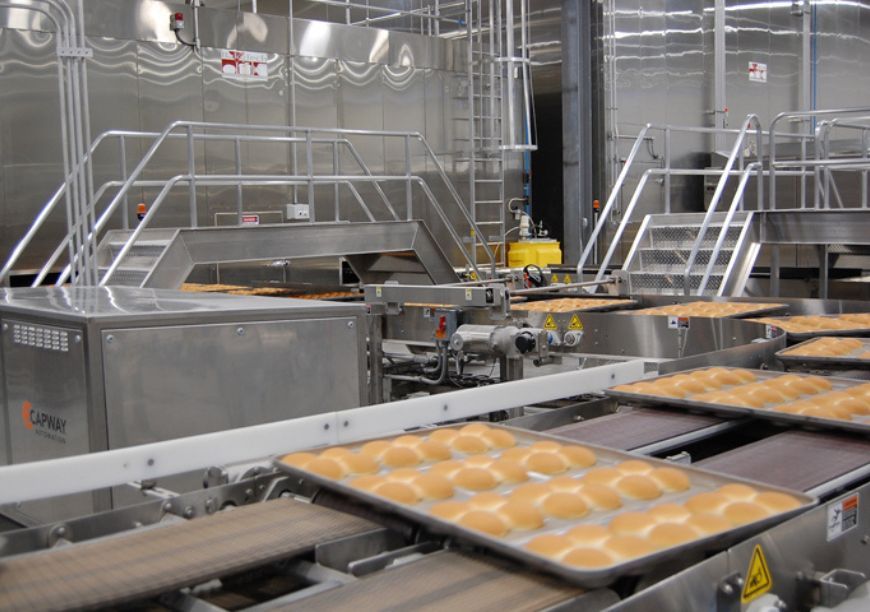
Industrial proofing machines are specialized bakery-processing systems used to provide controlled temperature and humidity conditions.
They help create a consistent environment in which yeast activity, dough expansion, and fermentation can develop according to a defined production process.
These systems are widely used in commercial bakeries and large-scale bread production facilities. Modern proofers can incorporate insulated chambers, heating systems, humidification units, sensors, conveyors, programmable controls, and automated material handling.
What Are Industrial Proofing Machines?
An industrial proofing machine, also known as an industrial dough proofer or proofing chamber, is equipment designed to maintain controlled environmental conditions around shaped dough before it enters the baking stage.
During proofing, yeast produces carbon dioxide through fermentation. The resulting gas becomes trapped within the dough structure, causing the dough to expand.
A proofing system controls important variables such as:
- Temperature
- Relative humidity
- Air circulation
- Residence time
- Product spacing
- Conveyor speed
Consistent control of these factors helps maintain uniform dough development throughout production.
How Do Industrial Proofing Machines Work?
Industrial proofing generally follows a controlled sequence.
1. Dough Preparation
Dough is mixed, developed, divided, and shaped according to the bakery's production process.
2. Product Loading
Shaped dough pieces are placed on trays, racks, pans, or a continuous conveyor system.
3. Controlled Environment
The products enter an insulated proofing chamber where temperature and humidity are maintained within the specified process range.
4. Fermentation
Yeast activity produces carbon dioxide, causing the dough to expand. Fermentation time varies according to formulation, yeast quantity, dough temperature, and the desired product characteristics.
5. Air Circulation
Fans distribute conditioned air throughout the chamber. Proper airflow helps minimize temperature and humidity variations.
6. Proofing Completion
Sensors and programmed controls maintain the selected conditions until the dough reaches the required development stage.
7. Transfer to Baking
The proofed dough moves to the next production stage, usually baking, through manual handling or an automated transfer system.
Types of Industrial Proofing Machines
Different proofer designs are used according to bakery size, product type, and production layout.
Batch Proofing Chambers
Batch proofers use enclosed chambers where trays or racks are loaded and removed as groups.
They can be suitable for bakeries producing multiple product varieties with different proofing requirements.
Conveyor Proofers
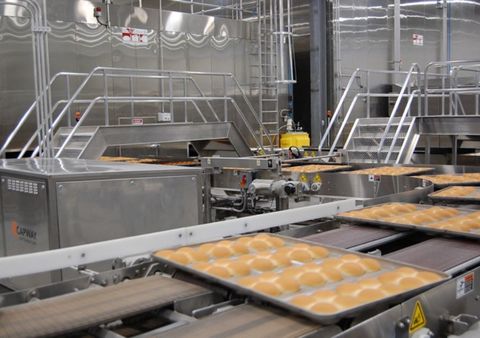
Conveyor proofers transport dough continuously through a controlled environment.
The conveyor speed determines the residence time, while different zones can provide controlled environmental conditions.
Spiral Proofers
Spiral proofers use a vertically arranged conveyor to maximize production capacity within a relatively compact floor area.
They are commonly integrated into automated bread and bakery production lines.
Multi-Level Proofers
Multi-level systems use stacked conveyor paths or rack arrangements to increase usable proofing capacity.
They can be designed for facilities where floor space is limited but production throughput is high.
Retarder-Proofers
Retarder-proofers combine cooling, holding, and controlled proofing functions. They allow dough development to be managed through programmed temperature changes.
These systems can provide greater scheduling flexibility for selected bakery processes.
Key Components of Industrial Proofing Machines
| Component | Primary Function |
|---|---|
| Insulated Chamber | Maintains controlled internal conditions |
| Heating System | Raises chamber temperature |
| Humidification System | Adds controlled moisture |
| Fans | Circulate conditioned air |
| Temperature Sensors | Monitor chamber temperature |
| Humidity Sensors | Monitor relative humidity |
| Conveyor | Moves dough through the chamber |
| Control Panel | Manages process parameters |
| PLC | Coordinates automated operation |
| Air Ducts | Distribute conditioned air |
| Cooling System | Reduces temperature when required |
Component configurations vary according to proofer design and production capacity.
Temperature and Humidity Control
Temperature and humidity are two of the most important process variables in dough proofing.
Temperature
Temperature affects yeast activity and fermentation rate. Higher temperatures can accelerate fermentation, while lower temperatures can slow it down.
The appropriate temperature depends on:
- Dough formulation
- Yeast type
- Product type
- Proofing duration
- Production schedule
Humidity
Humidity helps prevent excessive moisture loss from the dough surface.
Insufficient humidity can cause the dough surface to dry, while excessive condensation can create other production problems.
A controlled humidity environment can therefore support more consistent dough development.
Industrial Proofing Machine Specifications
Several specifications should be evaluated before selecting a proofer.
Capacity
Capacity can be expressed as:
- Trays per hour
- Dough pieces per hour
- Kilograms per hour
- Conveyor length
- Rack capacity
The appropriate measurement depends on the production configuration.
Temperature Range
The machine should provide the temperature range required by the bakery's fermentation process.
Humidity Range
Humidity-control capability should correspond to the dough formulation and product requirements.
Residence Time
Residence time is the period dough remains inside the proofing chamber. Conveyor speed, chamber length, and product spacing determine this parameter in continuous systems.
Conveyor Configuration
Conveyor width, belt type, elevation, speed range, and product spacing affect system capacity and integration with upstream and downstream equipment.
Applications of Industrial Proofing Machines
Industrial proofers are used across many bakery operations.
Bread Production
Proofing systems are used for:
- Loaves
- Buns
- Rolls
- Baguettes
- Specialty bread
- Multigrain products
Pizza Production
Pizza dough can undergo controlled fermentation before shaping, topping, and baking.
Hamburger and Sandwich Buns
High-volume bun production often uses automated proofing systems integrated between forming and baking equipment.
Flatbread Production
Selected flatbread processes may use controlled fermentation or intermediate dough-resting stages.
Sweet Dough Products
Products containing sugar, fats, eggs, and other ingredients can have different fermentation behavior, making controlled proofing conditions important.
Automation in Industrial Proofing Machines
Modern proofers can be integrated into automated bakery production lines.
Automation can control:
- Chamber temperature
- Humidity
- Conveyor speed
- Residence time
- Fan operation
- Heating
- Cooling
- Steam or humidification
- Product tracking
- Alarm conditions
PLC-Based Control
A programmable logic controller can coordinate multiple systems and maintain predefined proofing recipes.
Recipe Management
Digital controls can store product-specific programs containing:
- Temperature settings
- Humidity settings
- Conveyor speed
- Proofing duration
- Fan settings
- Heating and cooling parameters
This allows operators to switch between defined process programs.
Sensors and Monitoring
Sensors provide real-time information about the proofing environment.
Common measurements include:
- Temperature
- Relative humidity
- Conveyor speed
- Chamber pressure
- Motor condition
- Door position
Advanced systems can record historical process data for quality analysis and production traceability.
Proofing Uniformity
Uniform environmental conditions are important for consistent product development.
Potential sources of variation include:
- Uneven airflow
- Temperature gradients
- Humidity differences
- Product spacing
- Conveyor loading
- Chamber insulation
- Fan performance
Air-distribution design should therefore be considered during equipment selection and installation.
Energy Efficiency
Industrial proofers consume energy for heating, humidification, cooling, fans, and conveyor movement.
Efficiency can be influenced by:
- Chamber insulation
- Door sealing
- Heating-system efficiency
- Humidification control
- Fan efficiency
- Variable-speed drives
- Heat recovery
- Accurate temperature control
- Production scheduling
Avoiding unnecessary heating or cooling can help reduce energy consumption while maintaining the required proofing environment.
Common Industrial Proofing Problems
Excessive Dough Drying
Low humidity or excessive airflow can cause the dough surface to dry.
Excessive Condensation
High humidity combined with unsuitable temperature conditions can result in condensation on chamber surfaces or products.
Uneven Proofing
Temperature or humidity differences within the chamber can cause some dough pieces to develop faster than others.
Over-Proofing
Excessive residence time or unsuitable fermentation conditions can cause dough to expand beyond the desired stage.
Under-Proofing
Insufficient fermentation time or inappropriate environmental conditions can result in inadequate dough development.
Quality Control in Dough Proofing
Consistent proofing requires monitoring both machine parameters and product characteristics.
Environmental Monitoring
Temperature and humidity should be measured at appropriate points throughout the chamber.
Product Inspection
Dough can be evaluated for:
- Volume
- Shape
- Surface condition
- Expansion
- Texture
- Uniformity
Process Records
Automated systems can record proofing parameters and identify deviations from the selected recipe.
These records can help production teams investigate variations between batches or production periods.
Maintenance of Industrial Proofing Machines
Routine maintenance supports stable environmental control and hygienic operation.
Important maintenance activities include:
- Cleaning chamber surfaces
- Inspecting fans
- Checking heating elements
- Inspecting humidification systems
- Cleaning air ducts
- Checking temperature sensors
- Calibrating humidity sensors
- Inspecting conveyor components
- Checking insulation and door seals
- Inspecting electrical connections
- Testing safety systems
Cleaning procedures should follow equipment documentation and the bakery's sanitation program.
Food Hygiene Considerations
Proofing equipment operates in a food-production environment, so hygienic construction is important.
Useful design characteristics include:
- Smooth internal surfaces
- Corrosion-resistant materials
- Accessible cleaning areas
- Controlled moisture drainage
- Reduced product accumulation points
- Appropriate food-contact materials
- Easy access to inspection areas
Humidity systems should also be maintained properly to prevent unwanted microbial growth and contamination risks.
How to Select Industrial Proofing Machines
The appropriate proofer should be matched to the complete bakery process.
Consider:
- Product type
- Dough formulation
- Production capacity
- Proofing temperature
- Relative humidity
- Required residence time
- Conveyor configuration
- Available floor space
- Heating method
- Cooling requirements
- Automation level
- Cleaning requirements
- Energy efficiency
- Integration with ovens and other bakery equipment
For continuous production, the proofer should be synchronized with dough forming equipment and the industrial bakery oven.
Industrial Proofing Machines vs Batch Proofers
| Feature | Continuous Industrial Proofer | Batch Proofing Chamber |
|---|---|---|
| Production Method | Continuous | Batch-based |
| Throughput | High | Low to moderate |
| Automation | High | Variable |
| Residence-Time Control | Conveyor speed | Timed chamber cycle |
| Product Variety | More suited to standardized lines | Flexible for varied products |
| Production Integration | Strong | Often more independent |
The right configuration depends on production volume, product range, facility layout, and process scheduling.
How to Evaluate Industrial Proofing Machine Manufacturers
When evaluating manufacturers, consider both machine capabilities and bakery-process knowledge.
Important factors include:
- Proofer technology
- Capacity range
- Temperature-control accuracy
- Humidity-control capability
- Airflow design
- Conveyor engineering
- Insulation quality
- PLC and automation capabilities
- Recipe management
- Hygiene design
- Safety systems
- Testing procedures
- Maintenance requirements
- Integration with bakery production lines
Manufacturers should be able to explain how the system will maintain suitable environmental conditions throughout the proofing chamber.
Frequently Asked Questions
What are industrial proofing machines used for?
Industrial proofing machines provide controlled temperature and humidity conditions for dough fermentation before baking. They are commonly used for bread, rolls, buns, pizza dough, and other bakery products.
Why are temperature and humidity important during proofing?
Temperature influences yeast activity and fermentation rate, while humidity helps control moisture loss from the dough surface. Both parameters can affect dough development and final product characteristics.
What is a continuous dough proofer?
A continuous dough proofer uses a conveyor to move dough through a controlled chamber. Conveyor speed and chamber length determine the residence time.
What is a retarder-proofer?
A retarder-proofer combines controlled cooling, holding, and proofing functions. It can be used to manage dough fermentation according to a planned production schedule.
How do I select an industrial proofing machine?
Consider dough formulation, product type, capacity, temperature, humidity, proofing time, conveyor configuration, floor space, automation, sanitation, energy requirements, and integration with other bakery equipment.
Conclusion
Industrial proofing machines provide controlled fermentation environments that help bakery manufacturers maintain consistent dough development before baking. Batch chambers, conveyor proofers, spiral systems, multi-level designs, and retarder-proofers can address different production requirements.
Temperature, humidity, airflow, residence time, and product spacing are central to proofing performance. Accurate sensors, well-designed air distribution, appropriate insulation, and reliable controls help maintain stable chamber conditions.
Modern industrial proofers increasingly use PLC controls, recipe management, automated conveyors, digital sensors, and production monitoring. When integrated correctly with dough mixing, dividing, forming, and baking equipment, these systems can support a coordinated and consistent bakery production process.