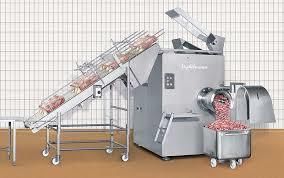
Industrial meat processing machinery is used to handle, cut, grind, mix, portion, cook, package, and prepare meat products for large-scale food production.
These machines help processing facilities maintain consistent product dimensions, controlled processing conditions, hygiene, and production throughput.
Modern meat processing lines can include individual machines or interconnected systems. Equipment selection depends on the type of meat, product format, processing stage, capacity, hygiene requirements, automation level, and facility layout.
What Is Industrial Meat Processing Machinery?
Industrial meat processing machinery includes specialized equipment designed to perform different stages of meat preparation and processing.
Depending on the production process, machinery can handle:
- Meat cutting
- Deboning
- Slicing
- Grinding
- Mixing
- Marinating
- Stuffing
- Forming
- Tenderizing
- Cooking
- Smoking
- Chilling
- Freezing
- Portioning
- Packaging
A complete production line may combine several machines to move meat through multiple processing stages with controlled material handling.
How Does Meat Processing Machinery Work?
The working sequence depends on the final product and processing method.
1. Raw Material Preparation
Raw meat is received, inspected, chilled, and prepared for processing.
2. Cutting and Portioning
Large pieces can be divided into smaller portions using saws, cutters, slicers, or portioning equipment.
3. Grinding
Suitable meat portions are processed through a grinder to achieve the required particle size.
4. Mixing and Formulation
Ground meat can be combined with ingredients, seasonings, or other formulation components using industrial mixers.
5. Forming or Stuffing
The mixture may be formed into products such as patties or portions, or transferred into casings using stuffing equipment.
6. Cooking or Thermal Processing
Products requiring cooking can pass through ovens, smokehouses, steam systems, or other controlled thermal-processing equipment.
7. Chilling and Freezing
Processed products are cooled or frozen to reach the required storage or handling temperature.
8. Packaging
The finished products can be portioned, sealed, labeled, and transferred to cold-storage or distribution operations.
Types of Industrial Meat Processing Machinery
Different machines perform specific processing functions.
Industrial Meat Cutters
Meat cutters divide large pieces into required portions or cuts.
Depending on the application, equipment can include:
- Band saws
- Circular saws
- Portion cutters
- Dicing machines
- Guillotine cutters
Cutting equipment should be selected according to meat dimensions, bone content, product format, and required portion accuracy.
Meat Grinders
Industrial meat grinders reduce meat into smaller particles using rotating cutting systems and perforated plates.
Grinding performance depends on:
- Plate hole diameter
- Knife configuration
- Feed rate
- Meat temperature
- Product composition
- Motor capacity
Different plate configurations can produce different particle sizes.
Meat Slicing Machines
Slicers produce consistent slices from suitable meat products.
They are used for products such as:
- Cooked meats
- Cured meats
- Deli products
- Ham
- Bacon
- Other processed meat products
Blade design, product temperature, feed mechanism, and slice thickness influence performance.
Meat Dicing Machines
Dicing equipment cuts meat into relatively uniform cubes or pieces.
These machines are useful for applications involving:
- Prepared foods
- Stews
- Ready-to-cook products
- Canned meat
- Processed formulations
Meat Mixers
Industrial mixers combine meat with ingredients and seasonings.
Ribbon, paddle, and other mixing systems can be selected according to product composition and viscosity.
Meat Stuffers
Stuffers transfer prepared meat mixtures into casings or other product formats.
Precise filling control can help maintain consistent product dimensions and weight.
Meat Forming Machines
Forming machines shape meat mixtures into standardized portions.
Common applications include:
- Patties
- Nuggets
- Meatballs
- Portions
- Other formed products
Meat Tenderizing Machines
Tenderizers use controlled mechanical action to modify the structure of suitable meat cuts.
Some systems use blades, needles, or rollers according to the application.
Industrial Meat Injectors
Injectors introduce marinades, brines, or other formulations into suitable meat products.
Controlled injection can improve distribution throughout the product.
Industrial Meat Packaging Machinery
Packaging equipment prepares processed meat products for storage and distribution.
Systems may include:
- Vacuum packaging machines
- Tray-sealing systems
- Thermoforming equipment
- Modified-atmosphere packaging systems
- Automatic weighing and packing systems
Key Components of Meat Processing Machinery
| Component | Main Function |
|---|---|
| Motor | Provides mechanical power |
| Cutting Blade | Performs cutting or slicing |
| Grinder Plate | Controls ground-meat particle size |
| Conveyor | Moves products between stages |
| Hopper | Holds material before processing |
| Mixing Shaft | Distributes ingredients |
| Control Panel | Manages machine functions |
| Sensors | Monitor process conditions |
| Drive System | Controls mechanical movement |
| Safety Guard | Protects operators from moving parts |
The component configuration varies according to machine type and processing application.
Food Hygiene and Sanitation
Hygiene is a fundamental consideration in meat processing facilities.
Equipment design may incorporate:
- Stainless-steel product-contact surfaces
- Smooth surfaces
- Welded construction
- Accessible cleaning areas
- Appropriate drainage
- Removable components
- Hygienic seals
- Controlled product pathways
Cleaning and sanitation procedures should follow applicable food-safety requirements and the facility's documented sanitation program.
Temperature Control in Meat Processing
Temperature management is important throughout meat processing.
Raw and processed meat may require controlled temperatures during:
- Storage
- Cutting
- Grinding
- Mixing
- Forming
- Cooking
- Chilling
- Freezing
Temperature monitoring can help maintain product quality and support food-safety controls.
Thermal processing requires carefully controlled time and temperature parameters based on the specific product and applicable regulations.
Automation in Meat Processing Machinery
Automation can connect multiple processing stages into an integrated production system.
Automated systems may control:
- Conveyor speed
- Cutting cycles
- Portion weight
- Grinding rate
- Mixing time
- Ingredient dosing
- Injection pressure
- Cooking temperature
- Chilling conditions
- Packaging operations
PLC-Based Control
Programmable logic controllers can coordinate motors, sensors, valves, conveyors, pumps, and other equipment.
Sensors and Monitoring
Sensors can monitor parameters such as:
- Temperature
- Product weight
- Position
- Speed
- Pressure
- Machine status
Data from these systems can support process monitoring and quality control.
Meat Processing Production Line
A typical production line may follow a sequence such as:
Receiving → Inspection → Chilling → Cutting → Grinding → Mixing → Forming/Stuffing → Cooking → Chilling → Packaging → Cold Storage
Not every facility uses every stage. The configuration depends on the products being manufactured.
Important Machinery Specifications
Processing Capacity
Capacity can be expressed in:
- Kilograms per hour
- Tons per hour
- Pieces per minute
- Portions per minute
- Batches per cycle
Capacity should be matched with upstream and downstream equipment.
Blade Configuration
Cutting and grinding machines require appropriate blade, knife, or plate configurations.
Blade geometry influences cutting quality and particle dimensions.
Motor Power
Motor power should correspond to the material characteristics and processing load.
Dense or frozen materials may require different drive characteristics than chilled, softer products.
Product Temperature
Processing temperature affects cutting behavior, grinding performance, texture, and product handling.
Portion Accuracy
For portioning and forming systems, repeatable weight and dimensions are important production parameters.
Quality Control in Meat Processing
Quality control can cover multiple stages.
Raw Material Inspection
Incoming materials can be evaluated for:
- Temperature
- Physical condition
- Traceability
- Foreign material
- Required specifications
Cutting Quality
Processed cuts can be checked for:
- Dimensions
- Weight
- Surface condition
- Consistency
Grinding Quality
Particle-size distribution can be monitored to maintain product specifications.
Forming and Portioning
Finished portions can be checked for weight, shape, dimensions, and consistency.
Packaging Inspection
Packaging can be checked for:
- Seal integrity
- Package condition
- Label accuracy
- Weight
- Product identification
Common Meat Processing Machinery Problems
Uneven Cutting
Dull blades, incorrect settings, inconsistent product feeding, or unsuitable machine configuration can result in uneven cuts.
Grinding Problems
Grinding performance can decline because of unsuitable temperature, worn knives or plates, excessive loading, or inappropriate feed conditions.
Product Clumping
Temperature, fat content, moisture, and mixing conditions can affect product behavior during processing.
Portion Variation
Inconsistent feeding, machine settings, product density, or forming-system wear can affect portion uniformity.
Packaging Seal Problems
Incorrect temperature, pressure, contamination around the sealing area, or unsuitable packaging materials can affect seal integrity.
Maintenance of Meat Processing Machinery
Regular maintenance is important for safe and consistent operation.
Typical maintenance activities include:
- Inspecting cutting blades
- Checking grinder plates and knives
- Inspecting bearings
- Checking belts and drive systems
- Lubricating appropriate components
- Inspecting seals and gaskets
- Cleaning product-contact areas
- Checking sensors
- Inspecting conveyors
- Testing safety switches
- Checking electrical connections
Cleaning procedures should distinguish between sanitation activities and mechanical maintenance.
How to Select Industrial Meat Processing Machinery
Selection should be based on the product and production process.
Consider:
- Meat type
- Bone content
- Product format
- Raw material temperature
- Processing capacity
- Cutting requirements
- Target particle size
- Portion dimensions
- Mixing requirements
- Cooking requirements
- Packaging format
- Hygiene requirements
- Automation level
- Available floor space
- Cleaning procedures
- Production-line integration
It is also important to assess how the selected machine will interact with equipment before and after the processing stage.
How to Evaluate Meat Processing Machinery Manufacturers
When evaluating machinery manufacturers, examine the technical characteristics of the equipment and its suitability for the intended application.
Important factors include:
- Machine configuration
- Processing capacity
- Product compatibility
- Materials of construction
- Cutting technology
- Automation
- Control systems
- Hygiene design
- Safety systems
- Cleaning accessibility
- Maintenance requirements
- Testing procedures
- Technical documentation
- Production-line integration
Equipment trials using representative raw materials can help determine whether the machine meets the required processing parameters.
Industrial vs Small-Scale Meat Processing Equipment
| Factor | Industrial Equipment | Small-Scale Equipment |
|---|---|---|
| Throughput | High | Lower |
| Automation | High potential | Generally simpler |
| Production Integration | Extensive | More limited |
| Capacity | Large | Small to medium |
| Process Monitoring | Advanced options | Basic to moderate |
| Continuous Operation | Common in suitable applications | Less common |
| Cleaning Systems | Specialized options | Generally simpler |
The appropriate equipment depends on production volume, product range, facility requirements, and process complexity.
Frequently Asked Questions
What is industrial meat processing machinery used for?
It is used for cutting, deboning, grinding, slicing, mixing, tenderizing, injecting, forming, stuffing, cooking, chilling, freezing, and packaging meat products.
What types of machines are used in meat processing plants?
Common equipment includes meat cutters, grinders, slicers, dicing machines, mixers, stuffers, forming machines, tenderizers, injectors, cooking systems, chilling equipment, and packaging machinery.
Why is temperature control important in meat processing?
Temperature affects product quality, machine performance, handling characteristics, and food-safety controls. Different processing stages require different temperature-management approaches.
Can meat processing machinery be automated?
Yes. Modern processing lines can integrate PLC controls, sensors, conveyors, automated dosing, weighing systems, forming equipment, cooking controls, and packaging systems.
How do I select industrial meat processing machinery?
Consider the meat type, bone content, product format, capacity, temperature, cutting or grinding requirements, portion specifications, hygiene requirements, automation, cleaning procedures, and production-line layout.
Conclusion
Industrial meat processing machinery supports multiple stages of modern meat production, from raw-material preparation and cutting to grinding, mixing, forming, thermal processing, chilling, and packaging. Different machines are designed for specific processing requirements, allowing facilities to configure equipment according to their product range and production workflow.
Hygienic construction, temperature control, equipment automation, process monitoring, and routine maintenance are important considerations. Machinery specifications such as capacity, motor power, blade configuration, portion accuracy, and product compatibility should be evaluated together rather than independently.
A well-designed processing line connects individual machines into a controlled workflow while maintaining appropriate hygiene and process conditions. Careful equipment selection can help manufacturers achieve consistent processing performance and integrate machinery effectively into large-scale food production.