Industrial dough mixers are specialized food-processing machines designed to combine flour.
They are widely used in commercial bakeries, food-processing plants, pizza production, confectionery operations, and large-scale bread manufacturing.
Modern mixing equipment is designed to provide controlled and repeatable mixing while handling large batches. Mixer selection depends on dough formulation, batch size, mixing intensity, production capacity, hydration level, temperature control, and the type of baked product being manufactured.
What Are Industrial Dough Mixers?
An industrial dough mixer is a mechanical system that combines ingredients and develops the required dough structure through controlled mechanical action.
Depending on the machine design, mixing can involve:
- Kneading
- Folding
- Stretching
- Compression
- Blending
- Aeration
The goal is to distribute ingredients uniformly while developing the desired dough characteristics.
Industrial mixers can range from compact production units to large automated systems integrated into continuous bakery production lines.
How Do Industrial Dough Mixers Work?
Although mixer designs vary, the basic process follows several stages.
1. Ingredient Loading
Flour, water, yeast, salt, fats, and other ingredients are introduced into the mixing bowl or trough according to the formulation.
Automated production systems may use weighing and ingredient-dosing equipment for greater consistency.
2. Initial Mixing
The mixing tool rotates and combines the ingredients into a relatively uniform mass.
3. Dough Development
Continued mechanical action develops the gluten structure and desired dough consistency. Mixing speed and duration depend on the formulation and product requirements.
4. Temperature Control
Mixing generates mechanical heat. Some industrial mixers incorporate cooling or temperature-management systems to help maintain the desired dough temperature.
5. Dough Discharge
Once the required mixing stage is complete, the dough is discharged for fermentation, dividing, forming, proofing, or other downstream processes.
Types of Industrial Dough Mixers
Different mixer configurations are used for different formulations and production environments.
Spiral Dough Mixers
Spiral mixers use a spiral-shaped mixing tool and rotating bowl or fixed bowl configuration depending on the design.
They are commonly used for:
- Bread dough
- Pizza dough
- Roll dough
- Lean dough
- High-hydration dough
Spiral mixers can provide effective dough development while handling relatively large batches.
Planetary Dough Mixers
Planetary mixers use a tool that rotates around its own axis while also moving around the mixing bowl.
Different attachments can be used for:
- Dough
- Batter
- Cream
- Filling mixtures
They are useful for bakeries producing a variety of formulations.
Horizontal Dough Mixers
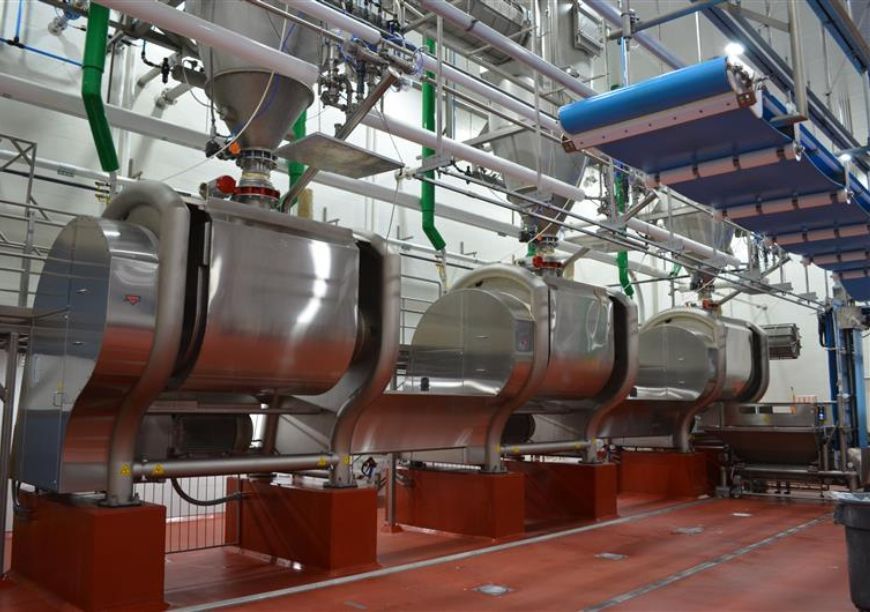
Horizontal mixers use horizontally positioned shafts or mixing tools inside a trough. They can handle large batches and are frequently used in industrial bakery and food-processing environments.
Twin-Arm Mixers
Twin-arm mixers use two mixing arms to provide a kneading and folding action. They can be used for specialized dough formulations requiring controlled mechanical development.
Continuous Dough Mixers
Continuous mixers combine ingredients and develop dough continuously rather than processing individual batches.
They are generally integrated into high-throughput automated production lines.
Key Components of Industrial Dough Mixers
| Component | Primary Function |
|---|---|
| Mixing Bowl or Trough | Holds ingredients during mixing |
| Mixing Tool | Performs blending and dough development |
| Electric Motor | Provides mechanical power |
| Gearbox | Transfers and controls rotational torque |
| Drive System | Connects motor to mixing mechanism |
| Control Panel | Controls mixing operation |
| Speed Controller | Adjusts mixing speed |
| Discharge Mechanism | Removes finished dough |
| Safety Guard | Protects operators from moving components |
| Temperature Sensor | Monitors dough or equipment temperature |
Construction materials and component dimensions vary according to mixer capacity and hygiene requirements.
Materials Used in Dough Mixer Construction
Food-contact surfaces are generally manufactured from materials that are suitable for food-processing environments.
Stainless Steel
Stainless steel is widely used for bowls, troughs, shafts, mixing tools, and other food-contact surfaces because of its corrosion resistance and cleanability.
Food-Grade Seals
Seals around shafts and moving interfaces must be compatible with food-processing conditions and cleaning procedures.
Engineering Polymers
Selected food-compatible polymers can be used for guards, scrapers, bearings, and other components depending on the machine design.
Industrial Dough Mixer Specifications
Several technical specifications should be evaluated before selecting a mixer.
Mixing Capacity
Capacity may be specified according to dough weight, flour weight, bowl volume, or batch size.
The actual usable capacity depends on dough density, hydration, formulation, and mixer configuration.
Motor Power
Motor power must be appropriate for the dough's resistance and the required batch size. Dense doughs generally place greater mechanical demands on the drive system.
Mixing Speed
Some mixers provide multiple speeds for different stages of mixing. Variable-speed control can provide greater flexibility for different formulations.
Bowl Configuration
Bowls can be:
- Fixed
- Removable
- Tilting
- Liftable
The appropriate design depends on production layout and dough-handling requirements.
Mixing Time
Mixing time varies according to ingredient composition, dough temperature, hydration, flour characteristics, and desired dough development.
Applications of Industrial Dough Mixers
Industrial dough mixers are used in a broad range of food-processing operations.
Bread Manufacturing
Large bakeries use industrial mixers for bread dough formulations, including:
- White bread
- Whole-grain bread
- Multigrain bread
- Specialty loaves
- Rolls
- Buns
Pizza Production
Pizza manufacturers use spiral and other specialized mixers for dough formulations requiring consistent elasticity and structure.
Pastry Production
Planetary and specialized mixers can process selected pastry formulations, fillings, and related bakery mixtures.
Tortilla and Flatbread Production
Industrial mixers prepare dough for tortillas, naan, chapati, pita, and other flatbread products.
Frozen Dough Production
Frozen bakery products require controlled dough preparation before dividing, shaping, freezing, and storage.
Food Processing
Dough mixers can also be integrated into production systems for various prepared dough-based foods.
Automation in Industrial Dough Mixing
Automation can improve consistency and reduce manual intervention.
Automated systems can integrate:
- Ingredient dosing
- Automated weighing
- Recipe management
- Mixing-speed control
- Temperature monitoring
- Automated discharge
- Bowl lifting
- Dough transfer
- Production data collection
Recipe Management
Digital controls can store predefined mixing programs. Operators can select a recipe and automatically apply specified mixing speeds and durations.
Sensor-Based Monitoring
Sensors can monitor:
- Dough temperature
- Motor load
- Mixing time
- Bowl position
- Mixing speed
- Equipment status
This information can help identify deviations during production.
Dough Temperature Control
Dough temperature is an important parameter because fermentation behavior and dough characteristics can change with temperature.
Industrial mixers can contribute significant heat through mechanical energy. Factors affecting final dough temperature include:
- Ingredient temperature
- Water temperature
- Mixing speed
- Mixing duration
- Dough formulation
- Ambient conditions
Some advanced systems use jacketed bowls or other cooling arrangements to manage temperature during intensive mixing.
Hygiene and Sanitation
Food-processing equipment must be designed for effective cleaning and sanitation.
Important design considerations include:
- Smooth food-contact surfaces
- Accessible components
- Reduced product-holding areas
- Appropriate seals
- Easy-to-clean mixing tools
- Corrosion-resistant materials
- Suitable drainage
- Hygienic machine construction
Cleaning procedures should follow the equipment manufacturer's instructions and the food-processing facility's sanitation program.
Quality Control in Dough Mixing
Consistent dough production requires control of both ingredients and mixing parameters.
Ingredient Measurement
Accurate ingredient measurement helps maintain formulation consistency.
Mixing Time
Under-mixing can result in incomplete ingredient distribution and insufficient dough development. Excessive mixing can change dough temperature and structure.
Dough Temperature
Temperature should be monitored because it can affect dough handling and downstream fermentation.
Dough Consistency
Operators can evaluate dough consistency through process measurements and standardized production checks.
Common Industrial Dough Mixer Problems
Inconsistent Mixing
Uneven mixing may result from excessive batch loading, inappropriate mixing-tool configuration, incorrect speed, or inconsistent ingredient distribution.
Excessive Temperature
High dough temperature can result from extended mixing, high speed, warm ingredients, or inadequate temperature management.
Motor Overload
Motor overload can occur when dense dough is processed beyond the machine's intended capacity or when mechanical problems increase resistance.
Product Build-Up
Dough accumulation around seals, mixing tools, or difficult-to-access areas can create hygiene and maintenance challenges.
Excessive Vibration
Vibration can be associated with mechanical imbalance, worn bearings, improper installation, or drive-system problems.
Maintenance of Industrial Dough Mixers
Regular maintenance supports reliable and hygienic operation.
Important maintenance activities include:
- Inspecting mixing tools
- Checking bearings
- Inspecting seals
- Lubricating designated components
- Checking drive belts or couplings
- Inspecting gearboxes
- Checking electrical connections
- Cleaning sensors
- Inspecting safety guards
- Checking emergency-stop systems
Maintenance schedules should follow manufacturer specifications and actual production conditions.
How to Select Industrial Dough Mixers
Selecting an appropriate mixer requires evaluating the complete production process.
Consider:
- Dough type
- Batch size
- Ingredient formulation
- Dough hydration
- Required mixing speed
- Motor power
- Mixing time
- Temperature-control requirements
- Bowl configuration
- Discharge method
- Cleaning requirements
- Automation level
- Available floor space
- Electrical requirements
For high-volume bakeries, integration with ingredient dosing, dough dividing, proofing, and transfer systems may also be important.
Industrial Dough Mixers vs Small Commercial Mixers
| Feature | Industrial Dough Mixers | Small Commercial Mixers |
|---|---|---|
| Batch Capacity | High | Low to moderate |
| Operating Cycle | Designed for repeated production | Typically shorter production cycles |
| Automation | Advanced options available | Usually simpler |
| Motor Configuration | Higher power ranges | Lower power ranges |
| Temperature Monitoring | Available on advanced systems | Less common |
| Production Integration | Can integrate with automated lines | Often standalone |
The appropriate machine depends on production scale, formulation, available space, and process requirements.
How to Evaluate Industrial Dough Mixer Manufacturers
When evaluating manufacturers, consider technical and production capabilities.
Important factors include:
- Mixer technology
- Capacity range
- Food-contact materials
- Motor and drive design
- Temperature-control options
- Automation capabilities
- Recipe management
- Hygienic design
- Safety systems
- Testing procedures
- Documentation
- Maintenance requirements
- Integration capabilities
The manufacturer should be able to match mixer configuration with the dough formulation, production volume, batch size, and downstream processing equipment.
Frequently Asked Questions
What are industrial dough mixers used for?
Industrial dough mixers combine flour, water, yeast, fats, salt, and other ingredients to produce consistent dough for bread, pizza, rolls, flatbreads, pastries, frozen dough products, and other food applications.
Which type of industrial dough mixer is commonly used for bread production?
Spiral mixers are commonly used for bread and pizza dough because their mixing action can effectively develop dough structure. Horizontal and continuous mixers may be used in larger production environments.
What determines the capacity of an industrial dough mixer?
Capacity depends on bowl or trough volume, dough weight, flour quantity, dough density, hydration, formulation, and the manufacturer's rated operating limits.
Why is dough temperature important during mixing?
Mixing generates mechanical heat, which can increase dough temperature. Temperature influences dough characteristics and subsequent fermentation, so controlled mixing conditions can be important for consistent production.
What should be considered when selecting an industrial dough mixer?
Important factors include dough formulation, batch capacity, motor power, mixing speed, mixing time, temperature control, bowl configuration, sanitation requirements, automation, and production-line integration.
Conclusion
Industrial dough mixers are essential components of large-scale bakery and food-processing operations. Spiral, planetary, horizontal, twin-arm, and continuous mixers provide different mixing actions and production capabilities for various dough formulations.
Machine performance depends on appropriate capacity, mixing-tool geometry, motor power, speed, mixing time, ingredient conditions, and temperature control. Hygienic construction and accessible cleaning features are also important in food-processing environments.
Modern industrial dough mixing systems increasingly integrate automated ingredient dosing, recipe management, sensors, temperature monitoring, automatic discharge, and production data collection. These technologies can support consistent dough preparation and integration with broader automated bakery production lines.