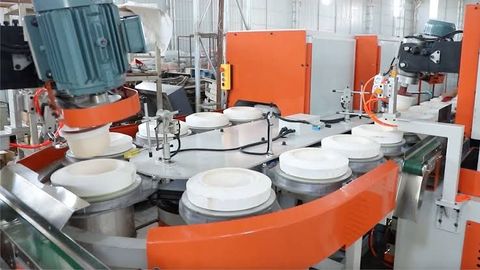
Industrial pottery machinery consists of specialized equipment used to prepare clay.
These machines help manufacturers produce pottery and ceramic products with consistent dimensions, shapes, surface quality, and firing characteristics.
Modern ceramic production can combine mechanical forming equipment with computerized controls, automated material handling, drying systems, glazing equipment, and industrial kilns. The appropriate machinery depends on clay composition, product geometry, production volume, firing temperature, surface finish, and automation requirements.
What Is Industrial Pottery Machinery?
Industrial pottery machinery includes equipment designed for different stages of ceramic and pottery production.
A typical production workflow may include:
- Raw material preparation
- Clay mixing
- Grinding and refining
- De-airing
- Forming
- Trimming
- Drying
- Glazing
- Decoration
- Firing
- Inspection
- Material handling
Different products require different combinations of these machines.
Examples of industrial pottery products include:
- Ceramic tableware
- Decorative pottery
- Flower pots
- Tiles
- Ceramic containers
- Sanitary ceramic products
- Artistic ceramic components
- Specialty ceramic parts
How Does Industrial Pottery Machinery Work?
The exact process depends on the product and forming technology.
1. Raw Material Preparation
Clay and other ceramic raw materials are measured and prepared according to the required formulation.
Materials may include:
- Clay
- Feldspar
- Silica
- Kaolin
- Alumina
- Ceramic additives
2. Mixing
Industrial mixers combine raw materials with water and selected additives to create a consistent ceramic body.
3. Refining and De-Air Removal
The clay may pass through refining equipment and a vacuum pugmill to remove air pockets and improve material consistency.
4. Forming
The prepared ceramic body is shaped using suitable forming equipment.
5. Drying
Controlled drying removes moisture from the formed product.
6. Glazing or Decoration
A glaze or decorative coating can be applied to selected products.
7. Firing
The shaped and dried product is heated inside a kiln according to a controlled firing schedule.
8. Inspection
The finished pottery is checked for dimensions, cracks, surface defects, color consistency, and other quality characteristics.
Types of Industrial Pottery Machinery
Different machines support specific stages of ceramic production.
Industrial Pottery Wheels
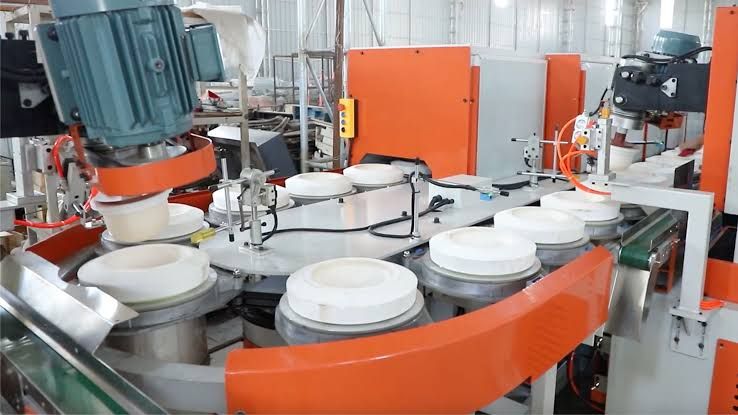
Pottery wheels rotate the ceramic body while the operator or forming mechanism shapes the material.
Industrial versions can incorporate:
- Variable-speed drives
- Foot or electronic controls
- Automatic centering
- Programmable operation
- Integrated forming systems
They are suitable for rotationally symmetrical products.
Jiggering Machines
Jigger machines form clay against a mold using a shaped tool.
They are commonly used for suitable ceramic tableware and rotational products.
Jolleying Machines
Jolleying systems are designed for shaping specific ceramic forms, particularly hollow or rotationally symmetrical products.
Hydraulic Presses
Hydraulic presses use controlled pressure to form ceramic materials against molds.
They can provide repeatable forming for suitable products.
Roller Forming Machines
Roller-head forming systems can shape ceramic bodies using rotating tools and molds.
They are commonly associated with industrial production of suitable tableware and ceramic components.
Slip Casting Equipment
Slip casting uses liquid ceramic slip poured into porous molds.
Water is absorbed by the mold, allowing a ceramic layer to form against the mold surface.
This method is useful for complex shapes that are difficult to produce through conventional plastic forming.
Extrusion Machines
Ceramic extrusion equipment forces prepared clay through a shaped die.
It can produce continuous profiles and components with consistent cross-sections.
Vacuum Pugmills
Vacuum pugmills mix, de-air, and compact clay.
Removing trapped air can improve the consistency and workability of the ceramic body before forming.
Industrial Ceramic Kilns
Kilns provide controlled heating for drying, firing, and selected finishing processes.
Common kiln configurations include:
- Batch kilns
- Tunnel kilns
- Roller-hearth kilns
- Shuttle kilns
The appropriate kiln depends on product geometry, firing temperature, production volume, and process requirements.
Major Components of Industrial Pottery Machinery
| Component | Primary Function |
|---|---|
| Clay Mixer | Blends ceramic materials |
| Pugmill | Processes and de-airs clay |
| Forming Unit | Shapes ceramic material |
| Mold | Defines product geometry |
| Hydraulic System | Provides forming pressure |
| Pottery Wheel | Rotates workpiece during forming |
| Dryer | Removes moisture |
| Glazing System | Applies glaze |
| Kiln | Fires ceramic products |
| Temperature Controller | Regulates thermal conditions |
| Conveyor | Transfers products |
| Control Panel | Manages machine operation |
Component configuration varies according to the production method.
Clay Processing Equipment
Clay preparation has a major influence on forming and firing behavior.
Clay Mixing
Industrial mixers create a consistent distribution of clay, water, and additives.
Grinding
Grinding equipment can reduce particle size and improve raw-material uniformity.
Screening
Screens remove oversized particles and unwanted material.
De-Air Removal
Vacuum processing reduces trapped air within the clay body.
Proper preparation can help minimize defects during forming and firing.
Pottery Forming Methods
Plastic Forming
Plastic clay is mechanically shaped using wheels, presses, molds, extruders, or forming tools.
Slip Casting
Liquid ceramic slip is introduced into porous molds to create hollow or complex components.
Dry Pressing
Ceramic powder or granulated material is compacted in a mold under controlled pressure.
Extrusion
Plastic ceramic material is forced through a die to create continuous shapes.
The appropriate method depends on product geometry, clay formulation, dimensional requirements, and production volume.
Industrial Pottery Drying Equipment
Drying removes moisture before firing.
Controlled drying is important because excessive drying rates can create internal stresses.
Industrial drying systems may include:
- Chamber dryers
- Tunnel dryers
- Continuous dryers
- Hot-air drying systems
Important drying parameters include:
- Temperature
- Humidity
- Air velocity
- Drying time
- Product spacing
Industrial Glazing Equipment
Glazing adds a glass-forming coating to the ceramic surface.
Industrial glazing methods can include:
- Spray glazing
- Dipping
- Curtain coating
- Flow coating
- Automated application
Automated systems can regulate coating thickness and movement speed.
Glaze preparation may involve mixing, grinding, screening, and controlled viscosity adjustment.
Ceramic Firing Equipment
Firing transforms the shaped ceramic body into a hardened ceramic product.
Batch Kilns
Batch kilns process a defined load at a time.
They provide flexibility for varied product types and firing schedules.
Tunnel Kilns
Tunnel kilns move products continuously through controlled heating zones.
They are suited to continuous industrial production.
Roller-Hearth Kilns
Roller-hearth systems transport products through the kiln using rollers.
They are commonly used for suitable flat or dimensionally stable ceramic products.
Shuttle Kilns
Shuttle kilns use movable kiln cars or similar arrangements for batch firing.
They can provide flexibility for different product sizes and firing schedules.
Firing Temperature and Atmosphere
Firing temperature depends on the ceramic body and glaze formulation.
Different pottery materials may be classified broadly as:
- Low-fire ceramics
- Mid-fire ceramics
- High-fire ceramics
Kiln atmosphere can also influence certain ceramic materials and glaze behavior.
Temperature controllers and thermocouples help maintain the required firing profile.
Applications of Industrial Pottery Machinery
Ceramic Tableware
Industrial pottery machinery can manufacture:
- Plates
- Bowls
- Cups
- Mugs
- Serving pieces
Forming, glazing, decoration, and firing can be integrated into a coordinated production line.
Decorative Pottery
Equipment can produce:
- Vases
- Sculptural forms
- Decorative vessels
- Ornamental ceramic pieces
Flower Pots and Planters
Forming and firing systems can manufacture ceramic planters in different sizes and shapes.
Sanitary Ceramics
Specialized ceramic production equipment can be used for suitable:
- Washbasins
- Ceramic fixtures
- Toilet components
- Related sanitary products
Technical Ceramics
Certain industrial forming and firing technologies can produce ceramic components used for specialized technical applications.
Automation in Industrial Pottery Machinery
Modern pottery production lines can incorporate automation throughout the manufacturing process.
Automation can control:
- Material feeding
- Clay mixing
- Forming
- Mold handling
- Drying
- Glazing
- Kiln temperature
- Conveyor movement
- Product inspection
PLC-Based Control
Programmable logic controllers can coordinate multiple machines and process stages.
Robotic Handling
Robotic systems can move fragile ceramic components between forming, drying, glazing, and firing stages.
Automated Glazing
Computer-controlled spray systems can maintain consistent glaze application on suitable products.
Kiln Monitoring
Digital control systems can monitor temperature zones, firing schedules, alarms, and other operating conditions.
Quality Control in Pottery Manufacturing
Quality control should be maintained throughout production.
Important inspection points include:
- Clay consistency
- Product dimensions
- Wall thickness
- Surface condition
- Moisture content
- Glaze thickness
- Color consistency
- Cracks
- Warping
- Firing temperature
- Final appearance
Dimensional Inspection
Precision measurement systems can verify product dimensions against defined specifications.
Surface Inspection
Visual or automated inspection can identify cracks, pinholes, glaze defects, chips, and other surface irregularities.
Common Industrial Pottery Machinery Problems
Cracking During Drying
Uneven moisture removal can create internal stresses and cracks.
Warping
Warping may result from uneven drying, inconsistent material composition, improper forming, or uneven firing.
Glaze Defects
Pinholes, crawling, blistering, or uneven coverage can result from glaze formulation, surface contamination, application conditions, or firing parameters.
Kiln Temperature Variation
Uneven temperature distribution can cause differences in color, shrinkage, strength, or glaze development.
Forming Inconsistency
Inconsistent clay moisture, mold wear, machine settings, or forming pressure can affect product dimensions.
Maintenance of Industrial Pottery Machinery
Routine maintenance helps maintain production consistency and machine reliability.
Typical activities include:
- Inspecting forming mechanisms
- Checking motors
- Inspecting bearings
- Cleaning clay-processing equipment
- Checking hydraulic systems
- Inspecting molds
- Maintaining conveyors
- Checking glazing nozzles
- Inspecting kiln components
- Testing temperature sensors
- Checking electrical controls
- Cleaning dust-collection systems
Maintenance schedules should follow equipment documentation and operating conditions.
How to Select Industrial Pottery Machinery
Machine selection should begin with the intended ceramic product and manufacturing process.
Consider:
- Product geometry
- Product dimensions
- Ceramic body composition
- Forming method
- Production volume
- Firing temperature
- Kiln capacity
- Glazing requirements
- Drying requirements
- Automation
- Material handling
- Quality-control systems
- Available factory space
- Maintenance requirements
For specialized pottery products, testing representative clay bodies and product designs can help establish suitable machine settings.
Manual vs Automated Pottery Production
| Factor | Manual Production | Automated Production |
|---|---|---|
| Operator Involvement | High | Lower |
| Production Consistency | Operator dependent | Higher potential |
| Production Capacity | Generally lower | Higher |
| Product Variety | High flexibility | Depends on equipment |
| Process Monitoring | Manual | Automated |
| Material Handling | Manual | Automated or robotic |
| Repeatability | Variable | High potential |
Many industrial facilities combine automated equipment with skilled operator oversight.
How to Evaluate Industrial Pottery Machinery Manufacturers
When evaluating industrial pottery machinery manufacturers, consider their equipment range and technical capabilities.
Important factors include:
- Clay-processing technology
- Forming equipment
- Press capacity
- Mold systems
- Drying technology
- Glazing equipment
- Kiln technology
- Temperature-control systems
- Automation
- Material handling
- Quality-control integration
- Technical documentation
- Maintenance requirements
A suitable manufacturer should be able to match the machinery configuration with the ceramic body, product dimensions, forming method, firing requirements, production volume, and automation objectives.
Energy Efficiency in Ceramic Production
Ceramic manufacturing can require significant thermal energy, particularly during drying and firing.
Energy consumption can be influenced by:
- Kiln design
- Firing temperature
- Thermal insulation
- Production loading
- Dryer efficiency
- Heat recovery
- Burner or heating technology
- Operating schedules
Efficient kiln insulation, appropriate loading, heat recovery, and process optimization can help reduce unnecessary thermal losses.
Frequently Asked Questions
What is industrial pottery machinery?
Industrial pottery machinery includes equipment used to prepare clay, form ceramic products, dry them, apply glaze or decoration, and fire the finished pieces.
What machines are used in pottery manufacturing?
Common equipment includes clay mixers, pugmills, pottery wheels, jiggering machines, presses, slip-casting systems, extruders, dryers, glazing machines, and industrial kilns.
What types of kilns are used in industrial pottery production?
Common industrial kiln types include batch kilns, tunnel kilns, roller-hearth kilns, and shuttle kilns. The appropriate kiln depends on product characteristics, firing temperature, production volume, and process requirements.
Why is clay preparation important?
Consistent clay preparation affects forming behavior, dimensional stability, drying, and firing. Mixing, refining, screening, and de-air removal can help create a more uniform ceramic body.
How do I select industrial pottery machinery?
Evaluate the product geometry, clay composition, forming method, production volume, drying requirements, glaze process, firing temperature, kiln capacity, automation, material handling, quality control, and available space.
Conclusion
Industrial pottery machinery combines clay-processing, forming, drying, glazing, firing, handling, and inspection technologies to support consistent ceramic production. Equipment such as pugmills, forming machines, presses, slip-casting systems, extruders, glazing systems, and industrial kilns can be configured into production lines for different pottery applications.
Production quality depends on clay preparation, forming accuracy, controlled drying, glaze application, kiln temperature, firing profile, and material handling. Automation can coordinate these stages through PLC controls, sensors, robotic handling, automated glazing, and digital kiln management.
When selecting industrial pottery machinery, manufacturers should evaluate the ceramic body, product geometry, forming method, production volume, firing requirements, automation, quality-control needs, and factory layout. Matching each machine to the complete production workflow helps create a coordinated and repeatable ceramic manufacturing process.