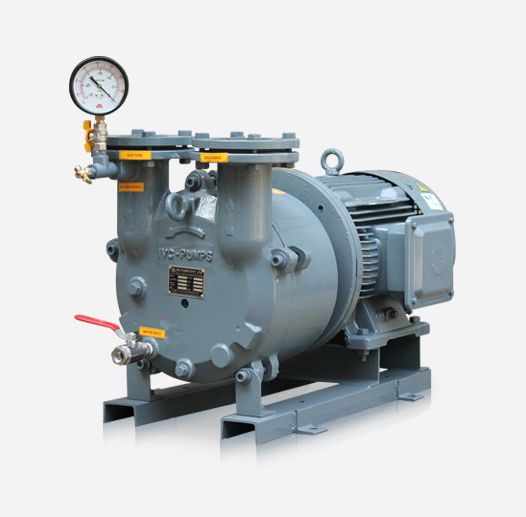
Industrial vacuum pump manufacturing involves producing equipment designed to remove gases and air from enclosed systems to create and maintain.
These pumps are essential in manufacturing, chemical processing, food production, pharmaceuticals, electronics, packaging, and laboratory applications.
Different vacuum technologies are designed for different pressure ranges, gas loads, temperatures, and process conditions. Manufacturing precision is particularly important because internal clearances, surface finishes, sealing systems, and component alignment can directly influence pump performance.
What Is an Industrial Vacuum Pump?
An industrial vacuum pump is a mechanical device that removes gas molecules from a sealed chamber or process system. As gas is continuously extracted, the pressure inside the system decreases below atmospheric pressure.
Vacuum pumps can be designed for different vacuum levels and operating requirements. The appropriate technology depends on factors such as:
- Required vacuum level
- Gas composition
- Gas flow rate
- Operating temperature
- Moisture content
- Chemical exposure
- Continuous or intermittent operation
- Contamination levels
Major Types of Industrial Vacuum Pumps
Manufacturers produce several vacuum pump technologies for industrial applications.
Rotary Vane Vacuum Pumps
Rotary vane pumps use rotating vanes inside a chamber to capture and compress gas before discharge. They are widely used for general industrial vacuum applications.
They can be configured as single-stage or two-stage systems depending on the required vacuum level.
Dry Screw Vacuum Pumps
Dry screw pumps use two screw rotors to transport and compress gases without introducing lubricating oil into the compression chamber.
They are particularly relevant where clean vacuum conditions and resistance to process contamination are important.
Liquid Ring Vacuum Pumps
Liquid ring pumps use a rotating impeller and a sealing liquid to create vacuum. Water is commonly used as the operating liquid, although other compatible liquids may be selected for specific processes.
Their ability to handle wet gases makes them useful in chemical, paper, mining, and process industries.
Claw Vacuum Pumps
Claw pumps use non-contacting claw-shaped rotors to move gas through the compression chamber. Their dry operating principle can reduce contamination associated with oil-lubricated compression chambers.
Diaphragm Vacuum Pumps
Diaphragm pumps use a flexible membrane to move gas. They can be suitable for applications requiring oil-free operation and resistance to certain chemical environments.
Roots Vacuum Pumps
Roots vacuum pumps use rotating lobes to transfer large volumes of gas. They are often used as booster pumps alongside other vacuum technologies when higher pumping capacity is required.
Components Used in Vacuum Pump Manufacturing
Industrial vacuum pumps consist of multiple precision-engineered components.
| Component | Primary Function |
|---|---|
| Pump Housing | Contains the internal pumping mechanism |
| Rotor | Moves or compresses gas |
| Vanes or Screws | Create the gas-transfer mechanism |
| Bearings | Support rotating components |
| Shaft | Transfers mechanical power |
| Seals | Control gas and lubricant leakage |
| Motor | Drives the pump |
| Inlet Port | Connects the pump to the vacuum system |
| Exhaust Port | Discharges extracted gases |
| Cooling System | Controls operating temperature |
| Control Unit | Monitors and manages operation |
The exact component configuration depends on the vacuum pump technology.
Industrial Vacuum Pump Manufacturing Process
Production combines machining, material processing, assembly, testing, and quality control.
1. Engineering and Design
Manufacturing begins with engineering specifications defining the target vacuum range, pumping speed, materials, dimensions, operating temperature, and application requirements.
Computer-aided design and simulation can be used to evaluate component geometry and gas-flow behavior before production.
2. Material Selection
Materials are selected according to mechanical loads, corrosion exposure, temperature, lubrication requirements, and process gases.
Common materials can include:
- Cast iron
- Stainless steel
- Carbon steel
- Aluminum alloys
- Engineering polymers
- Elastomers
- Specialized coatings
Stainless steel may be used where corrosion resistance is particularly important.
3. Casting or Fabrication
Pump housings and larger structural components may be produced through casting, machining, welding, or fabricated construction.
After initial forming, components undergo machining to achieve the specified dimensions.
4. Precision Machining
CNC machining is used to produce accurate bores, mounting surfaces, shaft interfaces, rotor profiles, and sealing surfaces.
Tight dimensional tolerances are particularly important for components where internal clearance affects pump efficiency.
5. Rotor Manufacturing
Rotors are manufactured using precision machining and finishing processes. Depending on the pump design, this can include screw rotors, claw rotors, lobes, vanes, or impellers.
Rotor balance and dimensional accuracy are carefully controlled to minimize vibration and maintain predictable operating characteristics.
6. Surface Finishing
Machined surfaces may undergo grinding, polishing, coating, or other finishing operations.
Surface quality is particularly important around:
- Shaft interfaces
- Sealing areas
- Rotor surfaces
- Bearing locations
- Internal pumping chambers
7. Assembly
Individual components are assembled according to engineering specifications. Bearings, shafts, seals, rotors, motors, lubrication systems, and control components are carefully aligned.
Incorrect alignment can increase vibration, friction, wear, and operating temperature.
8. Sealing and Leak Control
Vacuum systems require effective control of unwanted gas leakage. Seals, gaskets, mechanical seals, and connection interfaces are inspected during assembly.
Leak testing can identify unwanted pathways that could reduce vacuum performance.
9. Testing and Calibration
Completed pumps undergo functional and performance testing. Testing can include vacuum level, pumping speed, temperature, vibration, noise, power consumption, and leakage measurements.
Test procedures depend on the pump technology and intended application.
Manufacturing Equipment for Vacuum Pumps
Industrial vacuum pump production can require a broad range of specialized machinery.
| Manufacturing Equipment | Application |
|---|---|
| CNC Machining Centers | Precision component production |
| CNC Turning Machines | Shaft and cylindrical component machining |
| Grinding Machines | High-precision surface finishing |
| Balancing Machines | Rotor balancing |
| Coordinate Measuring Machines | Dimensional verification |
| Casting Equipment | Housing production |
| Welding Equipment | Fabricated structures |
| Assembly Stations | Pump integration |
| Vacuum Test Systems | Vacuum performance evaluation |
| Leak Detection Systems | Leak identification |
Automation can connect machining, inspection, assembly, and testing stages for repeatable production.
Quality Control in Vacuum Pump Manufacturing
Quality control is critical because vacuum performance can be affected by very small dimensional or assembly variations.
Dimensional Inspection
Manufacturers may inspect:
- Shaft diameter
- Rotor dimensions
- Internal clearances
- Housing dimensions
- Mounting interfaces
- Seal locations
- Bearing seats
Coordinate measuring machines and optical inspection equipment can provide detailed dimensional verification.
Rotor Balancing
Rotating components require appropriate balance to minimize vibration. Dynamic balancing equipment can identify and correct imbalance before final assembly.
Vacuum Testing
Vacuum testing determines whether the completed pump reaches its specified pressure range and maintains performance under defined operating conditions.
Leak Testing
Leak detection systems can identify unwanted gas entry through seals, joints, fittings, or other interfaces.
Vibration and Noise Testing
Abnormal vibration can indicate imbalance, misalignment, bearing problems, or mechanical interference. Monitoring these characteristics helps identify potential manufacturing issues.
Applications of Industrial Vacuum Pumps
Industrial vacuum pumps are used across many sectors.
Chemical Processing
Vacuum systems can support:
- Distillation
- Evaporation
- Drying
- Solvent recovery
- Filtration
- Degassing
Material compatibility is particularly important when handling corrosive or reactive gases.
Food Processing and Packaging
Vacuum equipment can be used for packaging, degassing, drying, conveying, and food-processing applications.
The pump configuration must match hygiene requirements and the type of gases or vapors being handled.
Pharmaceutical Manufacturing
Vacuum systems can support drying, filtration, solvent processing, vacuum concentration, and other controlled manufacturing operations.
Where contamination control is important, pump materials and operating principles must be carefully evaluated.
Electronics Manufacturing
Vacuum technology is used in processes such as semiconductor production, coating, drying, material handling, and controlled-atmosphere manufacturing.
Plastics and Rubber Processing
Vacuum systems can assist with degassing, extrusion processes, drying, and removal of trapped gases or moisture.
Packaging
Vacuum pumps are commonly integrated into packaging equipment for removing air from packages and supporting controlled packaging processes.
Factors Affecting Vacuum Pump Performance
Pumping Speed
Pumping speed indicates how quickly a pump can remove gas from a system. It is commonly expressed in units such as m³/h or CFM.
Ultimate Vacuum
Ultimate vacuum represents the lowest pressure the pump can theoretically achieve under specified conditions.
Gas Composition
Reactive, corrosive, condensable, or particulate-containing gases can require specialized pump materials and configurations.
Operating Temperature
Temperature affects lubricant behavior, sealing materials, gas properties, and overall pump performance.
Moisture and Condensation
Wet processes can create condensation inside the pump. Liquid-handling capability should therefore be considered when selecting equipment.
Internal Clearance
Clearances between moving and stationary components influence compression behavior, efficiency, and wear.
Oil-Lubricated vs Dry Vacuum Pumps
| Feature | Oil-Lubricated Pumps | Dry Vacuum Pumps |
|---|---|---|
| Lubrication | Uses oil in relevant pumping components | Designed without oil in the pumping chamber |
| Contamination Control | Requires lubricant management | Useful where oil contamination must be minimized |
| Common Technologies | Rotary vane | Dry screw, claw, scroll |
| Process Compatibility | Many general applications | Clean and specialized processes |
| Maintenance Requirements | Includes oil-related maintenance | Different wear and component maintenance requirements |
The appropriate technology depends on the process rather than one configuration being suitable for every application.
Automation in Vacuum Pump Manufacturing
Automation is increasingly used to improve production consistency and inspection accuracy.
Automated systems can assist with:
- CNC machining
- Rotor balancing
- Component measurement
- Automated assembly
- Leak testing
- Vacuum testing
- Performance monitoring
- Production traceability
Machine vision can inspect surfaces and assemblies for visible defects, while digital measurement systems can record dimensional data throughout production.
How to Evaluate Industrial Vacuum Pump Manufacturers
Technical evaluation should focus on the manufacturer's engineering and production capabilities.
Important factors include:
- Vacuum technology expertise
- Pumping-speed range
- Pressure-range capabilities
- Material options
- Precision machining capabilities
- Rotor balancing facilities
- Leak-testing equipment
- Vacuum testing capabilities
- Quality management procedures
- Custom engineering capabilities
- Application knowledge
- Spare-component availability
The manufacturer should be able to match pump design with the process gases, required pressure range, operating schedule, and environmental conditions.
Maintenance of Industrial Vacuum Pumps
Regular maintenance helps maintain stable vacuum performance and mechanical reliability.
Common maintenance activities include:
- Checking lubricant condition where applicable
- Inspecting seals and gaskets
- Cleaning inlet filters
- Checking exhaust systems
- Monitoring operating temperature
- Inspecting bearings
- Checking vibration
- Inspecting drive couplings
- Checking vacuum performance
- Testing for leakage
Maintenance intervals should follow manufacturer documentation and be adjusted according to actual operating conditions.
Frequently Asked Questions
What is industrial vacuum pump manufacturing?
Industrial vacuum pump manufacturing is the process of designing, machining, assembling, and testing pumps that remove gases from enclosed systems to create controlled vacuum conditions.
Which materials are commonly used for vacuum pumps?
Cast iron, stainless steel, carbon steel, aluminum alloys, engineering polymers, elastomers, and specialized coatings may be used depending on the pump design and process environment.
What are the main types of industrial vacuum pumps?
Common types include rotary vane, dry screw, liquid ring, claw, diaphragm, scroll, and Roots vacuum pumps. Each technology has different operating characteristics and application areas.
Why is leak testing important in vacuum pump manufacturing?
Leak testing helps identify unwanted gas entry through seals, joints, fittings, or other interfaces. Even small leaks can affect the ability of a vacuum system to reach its required pressure.
How do I select an industrial vacuum pump?
Selection should consider required vacuum level, pumping speed, gas composition, moisture content, temperature, contamination, operating schedule, material compatibility, and maintenance requirements.
Conclusion
Industrial vacuum pump manufacturing combines precision engineering, material selection, CNC machining, rotor production, component assembly, sealing technology, and performance testing. Different pump technologies are designed for different vacuum ranges and process conditions.
Rotary vane, dry screw, liquid ring, claw, diaphragm, scroll, and Roots technologies each have specific characteristics that determine their suitability for particular industrial applications. Factors such as pumping speed, ultimate vacuum, gas composition, moisture, temperature, and contamination should be considered together.
Advanced machining, automated inspection, digital monitoring, rotor balancing, and leak-testing technologies are helping manufacturers improve consistency and reliability across modern vacuum pump production.